At the Intersection of Animal-Human Romance Tales, Boundary Theory, and Yuri-Aware Reading
Introduction
Tamamizu Monogatari is generally treated as an otogizōshi (a short medieval tale) from the Muromachi period. It also became newly visible to many modern readers after it appeared on the 2019 National Center Test (classical Japanese section), where it sparked discussion online and in popular commentary.
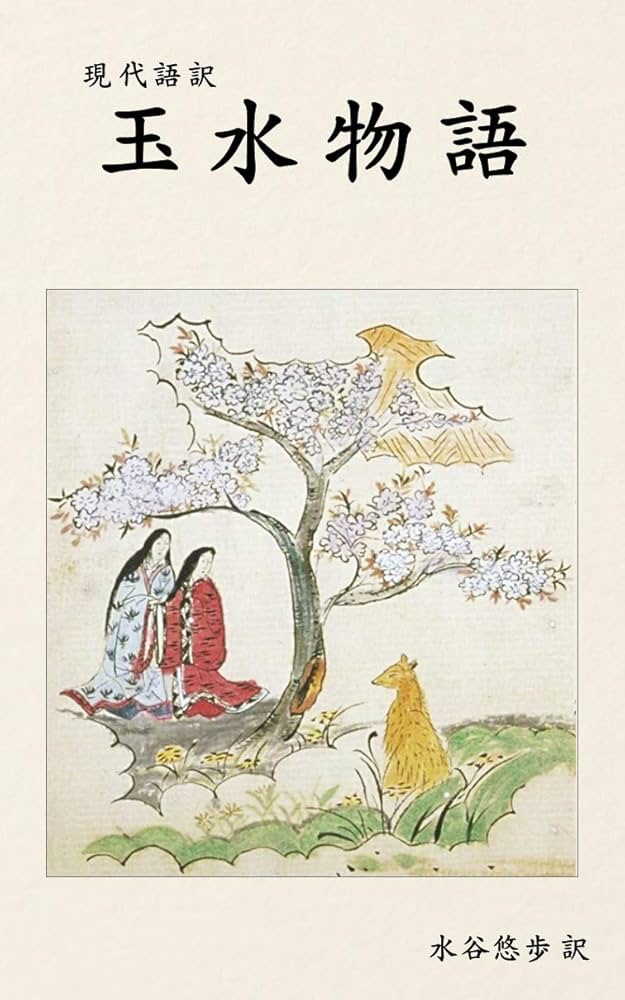
A useful modern entry point is the Kyoto University Rare Materials Digital Archive, which provides a reader-friendly illustrated synopsis (and explicitly notes that the synopsis prioritizes accessibility rather than being a strict modern translation). Based on that summary and related catalog notes, the story can be outlined like this: a fox falls in love with a noble princess, chooses not to approach her as a man, transforms into a beautiful young girl instead, enters human society through an adoptive household, and eventually serves the princess as a lady-in-waiting under the name Tamamizu no Mae. The relationship deepens, but the fox later leaves, revealing the truth only afterward through a letter and a box, and the princess is left to recognize the pathos of Tamamizu’s hidden devotion.
This work is sometimes talked about today as “yuri-like,” but its significance goes far beyond internet labels. What makes it so rich is the way it compresses, within a relatively short tale, several different structures at once: an animal-human love story, a gendered transformation, courtly intimacy, secrecy, and the tragedy of a being who can cross boundaries but cannot remain safely inside them. The result is a text that rewards both literary and contemporary cultural reading.
1. A Basic Point to Get Right First
Tamamizu Monogatari is a story about a fox who falls in love with a princess and appears before her in female form
This point matters, because if we miss it, the whole reading axis shifts.
In modern summaries of the tale, the fox first considers becoming a man in order to approach the princess, but abandons that idea out of concern that it could bring her harm. Instead, the fox chooses to transform into a young girl, enters human society through another household, and then draws close to the princess by serving her as a woman attendant.
That narrative choice is structurally crucial. The fox does not pursue straightforward possession or marriage. It chooses proximity instead. The emotional center of the tale is not “winning” the princess but remaining near her, even at the cost of concealment. This is one reason the story feels so delicate and painful to modern readers.
2. Reading It as an Animal-Human Romance Tale
But more precisely, as a variation on that form
From a more academic angle, Tamamizu Monogatari is often best understood in relation to animal-human marriage/romance tales (a broader class of stories in which a human and a non-human being form an intimate bond).
It shares a recognizable skeleton with that tradition:
- a non-human being falls in love with a human
- it takes human form
- a relationship becomes possible
But Tamamizu Monogatari also departs from common patterns in a striking way. Kyoto University’s catalog explanation explicitly notes the unusualness of the setup: instead of the fox transforming into a man and pursuing the princess directly, it transforms into a same-sex female form and serves her.
As a result, the relationship does not unfold primarily as a marriage plot. It takes shape instead as courtly service plus intimacy. That shift changes where the emotional heat of the story goes. The tale is less about the successful completion of romance than about the joy of nearness and the grief of losing that nearness.
3. A Boundary-Theory Reading
The fox mediates between human/non-human, male/female, inside/outside
From the perspective of boundary theory, Tamamizu is consistently an “in-between” being.
3.1 Species Boundary
Tamamizu is a fox, not a human. Yet Tamamizu enters human society, is taken in through an adoptive household, and functions within a noble courtly environment as a lady-in-waiting. This is not merely anthropomorphism. It is a temporary insertion of a non-human being into a highly structured human order.
3.2 Gender Boundary
This is one of the most important points in the story. The fox briefly contemplates approaching the princess in male form, then rejects that route and chooses to appear as a young woman. In that sense, Tamamizu’s gendered presentation is not simply an essence but a relationally selected form, chosen as the mode through which intimacy can become possible.
3.3 Spatial Boundary
Kyoto University’s summary and catalog notes also preserve details that highlight Tamamizu’s movement between worlds, including courtly scenes and episodes involving the fox’s own kin. Tamamizu belongs neither fully to the court nor fully to the fox world. This mobility marks Tamamizu as a figure who can cross worlds, but cannot be fully absorbed by either.
3.4 Ethical Boundary
In the episode involving possession/illness (as summarized in the archive materials), Tamamizu is not only a lover figure but also a mediator who intervenes between human and fox-side conflict. This positions Tamamizu as an ethical agent, not just a romantic subject.
Taken together, these layers show that Tamamizu is not simply “the protagonist of a fox love story.” Tamamizu is also a being who manages traffic across boundaries.
4. Points of Contact with Yuri Culture
Not “this is simply yuri,” but “there are strong conditions for a yuri-aware reading”
This part is worth explaining carefully, especially for readers who may not know the term yuri.
4.0 What is “yuri” (beginner-friendly explanation)
In Japanese pop culture, yuri is a term generally used for works, expressions, or reading practices centered on close relationships between women.
But yuri does not always mean only one thing. Depending on the work and the reading community, it can include:
- explicitly romantic relationships between women
- relationships that hover between friendship and romance
- intense admiration, attachment, or longing
- forms of intimacy that resist clear naming
- stories where separation or loss is part of what gives the relationship meaning
So in practice, yuri can function not only as a genre label but also as a way of reading intimacy, especially intimacy marked by delicacy, ambiguity, and emotional distance.
That is the sense in which yuri becomes useful here.
4.1 A Necessary Caution First
It is still important to be careful. Tamamizu Monogatari is a medieval text, while modern yuri culture developed much later through modern and contemporary print culture, manga, anime, and fan/critical communities. These are not the same historical or media conditions.
So this essay does not claim that Tamamizu Monogatari is simply “a yuri work” in the modern genre sense.
Instead, the claim is narrower and more useful: a yuri-aware reading sensibility can illuminate how this text stages intimacy, secrecy, and loss.
4.2 Why Tamamizu Monogatari is so often read as “yuri-like”
Even with that caution, it is not surprising that modern readers often respond to the tale in yuri-adjacent ways. The text offers a remarkably strong representation of intimacy that appears, on the surface and in social form, as a relationship between women: Tamamizu in the form of a young woman serving the princess in close daily proximity. The 2019 test reception is one visible sign of how strongly that reading response can emerge.
Several features make this especially resonant with yuri-oriented reading practices:
- A relationship that appears as woman-to-woman intimacy
Tamamizu approaches and remains beside the princess in female form, as a lady-in-waiting. - Strong selective intimacy
The princess gives Tamamizu particular attention and affection in ways that exceed ordinary service. (Modern summaries emphasize this special favor.) - Fine-grained emotional exchange
The story uses letters, poems, tears, concern, and emotional misalignment as part of its dramatic texture, making intimacy legible through affect rather than formal declaration. - A hidden core
Tamamizu’s true nature and desire are central to the relationship, yet cannot be openly stated. - Truth arriving after separation
The emotional meaning of the bond becomes fully legible only after departure, through the box and letter.
These structures strongly resonate with many yuri readings that value “unsayable” relationships, intimacy without stable social naming, and feelings whose full contour appears only through loss.
4.3 Why the tale still cannot be reduced to “just yuri”
At the same time, there are clear reasons not to collapse the work into a modern yuri category.
- Tamamizu’s original form is a fox
- in modern explanatory accounts, the fox is described as male before transforming into a young woman
- the relationship is shaped by medieval court structures, rank, and the princess’s eventual movement into imperial/courtly institutions (as summarized in the archive materials)
- the ending is not “romantic fulfillment” but departure, revelation, and retrospective pathos
In other words, the text resists clean classification, which is precisely why it is so interesting.
The better question is not “Is it yuri or not?” but Where and how does a yuri-like reading become possible?
5. Shared Emotional Structures Between Tamamizu Monogatari and Yuri Reading Culture
A key phrase: unreachable closeness
The strongest points of contact are not at the level of genre identity, but at the level of emotional structure.
5.1 Close, but unreachable
Tamamizu is physically and socially close to the princess, present in daily life, emotionally legible, and deeply attached. Yet the core truth of that bond cannot be spoken in real time.
This creates a painful distance: physically near, existentially far.
That structure feels familiar to many yuri readings, where intimacy can be intense but still unable to fully cross the thresholds that define it.
5.2 A bond outside formal institutions
The princess moves toward a courtly future that can be named and institutionally recognized. Tamamizu’s bond with her cannot be stabilized in that way.
In contemporary terms, this can be read as a form of non-institutional intimacy. That issue has long been central to many yuri works and yuri-centered reading practices, where the relationship matters deeply even when social language and institutions do not know how to house it.
5.3 Separation does not negate the relationship
Tamamizu does not remain and openly confess in a way that renews the relationship within the same frame. Instead, the truth is delivered after departure.
The princess understands the meaning of the bond through absence.
This is not simply “failure.” It is a structure in which separation becomes the condition under which emotional depth becomes visible. That logic also resonates strongly with yuri traditions that treat loss, delayed understanding, and aftereffects as meaningful rather than secondary.
5.4 Intimacy does not erase boundaries, it reveals them
This is where the boundary-theory reading and yuri-aware reading most clearly meet.
In Tamamizu Monogatari, intimacy does not dissolve the boundaries between:
- human and non-human
- appearance and underlying form
- court interior and outside world
- being near someone and being able to live with them
Instead, intimacy makes those boundaries sharper and more painful.
A similar dynamic appears in some yuri readings as well. Closeness does not always remove social or existential limits. Sometimes it makes those limits newly visible.
5.5 An important reservation
These parallels are points of contact in reading, not proof of historical genre identity.
- Tamamizu Monogatari belongs to medieval Japanese tale culture
- modern yuri culture belongs to much later media systems, reading communities, and critical vocabularies
If we flatten that difference and say only “it was yuri all along,” we lose what is most valuable in both.
A more productive approach is to ask which modern reading frameworks can illuminate older texts, and where their limits are. In that sense, yuri culture is not just a label for classification here. It is a modern affective and interpretive tool for receiving the tale’s structures of intimacy, secrecy, crossing, and loss.
6. A Useful Reading Principle
This is not just a “true identity reveal” story, but a story about the form of a relationship
From a contemporary angle, it is tempting to summarize the tale as a fox-disguise story whose main point is eventual revelation.
But that summary is too thin.
What makes the work powerful is not only what Tamamizu is, but:
- how Tamamizu draws near
- what form of closeness becomes possible
- why that closeness cannot continue indefinitely
- when and how truth is allowed to arrive
In that sense, Tamamizu Monogatari is not exhausted by any single frame, not “just” an animal tale, not “just” a love story, not “just” a yuri-like reading object. It remains compelling because multiple interpretive frameworks remain active at once.
Conclusion
Tamamizu Monogatari is a medieval otogizōshi, but it continues to speak to contemporary readers with surprising force. A fox falls in love with a princess and chooses, not the route of direct male pursuit, but the path of becoming a young woman and standing beside her in service. That choice transforms the narrative from a straightforward animal-human romance into a story of service, secrecy, intimacy, and separation.
It is precisely this transformation that makes the tale so resonant for modern readers, including those shaped by yuri reading culture. This does not mean a modern genre category can be simply projected backward into the medieval period. It means something more interesting: older texts can still challenge and refine the ways we read closeness, desire, and loss across radically different historical worlds.
Tamamizu Monogatari feels contemporary not because it is secretly modern, but because it tests the limits of our reading in the present.
Leave a Reply