Author: mashiro

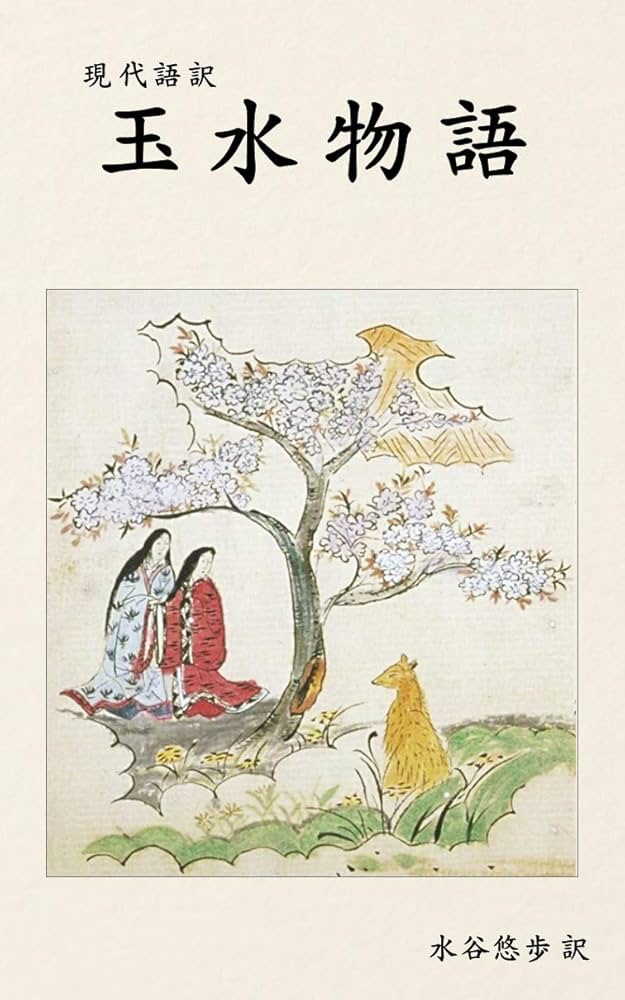
  • A Fox, a Princess, and a Secret Love: Reading Tamamizu Monogatari

    At the Intersection of Animal-Human Romance Tales, Boundary Theory, and Yuri-Aware Reading

    Introduction

    Tamamizu Monogatari is generally treated as an otogizōshi (a short medieval tale) from the Muromachi period. It also became newly visible to many modern readers after it appeared on the 2019 National Center Test (classical Japanese section), where it sparked discussion online and in popular commentary.

    A useful modern entry point is the Kyoto University Rare Materials Digital Archive, which provides a reader-friendly illustrated synopsis (and explicitly notes that the synopsis prioritizes accessibility rather than being a strict modern translation). Based on that summary and related catalog notes, the story can be outlined like this: a fox falls in love with a noble princess, chooses not to approach her as a man, transforms into a beautiful young girl instead, enters human society through an adoptive household, and eventually serves the princess as a lady-in-waiting under the name Tamamizu no Mae. The relationship deepens, but the fox later leaves, revealing the truth only afterward through a letter and a box, and the princess is left to recognize the pathos of Tamamizu’s hidden devotion.

    This work is sometimes talked about today as “yuri-like,” but its significance goes far beyond internet labels. What makes it so rich is the way it compresses, within a relatively short tale, several different structures at once: an animal-human love story, a gendered transformation, courtly intimacy, secrecy, and the tragedy of a being who can cross boundaries but cannot remain safely inside them. The result is a text that rewards both literary and contemporary cultural reading.


    1. A Basic Point to Get Right First

    Tamamizu Monogatari is a story about a fox who falls in love with a princess and appears before her in female form

    This point matters, because if we miss it, the whole reading axis shifts.

    In modern summaries of the tale, the fox first considers becoming a man in order to approach the princess, but abandons that idea out of concern that it could bring her harm. Instead, the fox chooses to transform into a young girl, enters human society through another household, and then draws close to the princess by serving her as a woman attendant.

    That narrative choice is structurally crucial. The fox does not pursue straightforward possession or marriage. It chooses proximity instead. The emotional center of the tale is not “winning” the princess but remaining near her, even at the cost of concealment. This is one reason the story feels so delicate and painful to modern readers.


    2. Reading It as an Animal-Human Romance Tale

    But more precisely, as a variation on that form

    From a more academic angle, Tamamizu Monogatari is often best understood in relation to animal-human marriage/romance tales (a broader class of stories in which a human and a non-human being form an intimate bond).

    It shares a recognizable skeleton with that tradition:

    • a non-human being falls in love with a human
    • it takes human form
    • a relationship becomes possible

    But Tamamizu Monogatari also departs from common patterns in a striking way. Kyoto University’s catalog explanation explicitly notes the unusualness of the setup: instead of the fox transforming into a man and pursuing the princess directly, it transforms into a same-sex female form and serves her.

    As a result, the relationship does not unfold primarily as a marriage plot. It takes shape instead as courtly service plus intimacy. That shift changes where the emotional heat of the story goes. The tale is less about the successful completion of romance than about the joy of nearness and the grief of losing that nearness.


    3. A Boundary-Theory Reading

    The fox mediates between human/non-human, male/female, inside/outside

    From the perspective of boundary theory, Tamamizu is consistently an “in-between” being.

    3.1 Species Boundary

    Tamamizu is a fox, not a human. Yet Tamamizu enters human society, is taken in through an adoptive household, and functions within a noble courtly environment as a lady-in-waiting. This is not merely anthropomorphism. It is a temporary insertion of a non-human being into a highly structured human order.

    3.2 Gender Boundary

    This is one of the most important points in the story. The fox briefly contemplates approaching the princess in male form, then rejects that route and chooses to appear as a young woman. In that sense, Tamamizu’s gendered presentation is not simply an essence but a relationally selected form, chosen as the mode through which intimacy can become possible.

    3.3 Spatial Boundary

    Kyoto University’s summary and catalog notes also preserve details that highlight Tamamizu’s movement between worlds, including courtly scenes and episodes involving the fox’s own kin. Tamamizu belongs neither fully to the court nor fully to the fox world. This mobility marks Tamamizu as a figure who can cross worlds, but cannot be fully absorbed by either.

    3.4 Ethical Boundary

    In the episode involving possession/illness (as summarized in the archive materials), Tamamizu is not only a lover figure but also a mediator who intervenes between human and fox-side conflict. This positions Tamamizu as an ethical agent, not just a romantic subject.

    Taken together, these layers show that Tamamizu is not simply “the protagonist of a fox love story.” Tamamizu is also a being who manages traffic across boundaries.


    4. Points of Contact with Yuri Culture

    Not “this is simply yuri,” but “there are strong conditions for a yuri-aware reading”

    This part is worth explaining carefully, especially for readers who may not know the term yuri.

    4.0 What is “yuri” (beginner-friendly explanation)

    In Japanese pop culture, yuri is a term generally used for works, expressions, or reading practices centered on close relationships between women.

    But yuri does not always mean only one thing. Depending on the work and the reading community, it can include:

    • explicitly romantic relationships between women
    • relationships that hover between friendship and romance
    • intense admiration, attachment, or longing
    • forms of intimacy that resist clear naming
    • stories where separation or loss is part of what gives the relationship meaning

    So in practice, yuri can function not only as a genre label but also as a way of reading intimacy, especially intimacy marked by delicacy, ambiguity, and emotional distance.

    That is the sense in which yuri becomes useful here.

    4.1 A Necessary Caution First

    It is still important to be careful. Tamamizu Monogatari is a medieval text, while modern yuri culture developed much later through modern and contemporary print culture, manga, anime, and fan/critical communities. These are not the same historical or media conditions.

    So this essay does not claim that Tamamizu Monogatari is simply “a yuri work” in the modern genre sense.

    Instead, the claim is narrower and more useful: a yuri-aware reading sensibility can illuminate how this text stages intimacy, secrecy, and loss.

    4.2 Why Tamamizu Monogatari is so often read as “yuri-like”

    Even with that caution, it is not surprising that modern readers often respond to the tale in yuri-adjacent ways. The text offers a remarkably strong representation of intimacy that appears, on the surface and in social form, as a relationship between women: Tamamizu in the form of a young woman serving the princess in close daily proximity. The 2019 test reception is one visible sign of how strongly that reading response can emerge.

    Several features make this especially resonant with yuri-oriented reading practices:

    • A relationship that appears as woman-to-woman intimacy
      Tamamizu approaches and remains beside the princess in female form, as a lady-in-waiting.
    • Strong selective intimacy
      The princess gives Tamamizu particular attention and affection in ways that exceed ordinary service. (Modern summaries emphasize this special favor.)
    • Fine-grained emotional exchange
      The story uses letters, poems, tears, concern, and emotional misalignment as part of its dramatic texture, making intimacy legible through affect rather than formal declaration.
    • A hidden core
      Tamamizu’s true nature and desire are central to the relationship, yet cannot be openly stated.
    • Truth arriving after separation
      The emotional meaning of the bond becomes fully legible only after departure, through the box and letter.

    These structures strongly resonate with many yuri readings that value “unsayable” relationships, intimacy without stable social naming, and feelings whose full contour appears only through loss.

    4.3 Why the tale still cannot be reduced to “just yuri”

    At the same time, there are clear reasons not to collapse the work into a modern yuri category.

    • Tamamizu’s original form is a fox
    • in modern explanatory accounts, the fox is described as male before transforming into a young woman
    • the relationship is shaped by medieval court structures, rank, and the princess’s eventual movement into imperial/courtly institutions (as summarized in the archive materials)
    • the ending is not “romantic fulfillment” but departure, revelation, and retrospective pathos

    In other words, the text resists clean classification, which is precisely why it is so interesting.

    The better question is not “Is it yuri or not?” but Where and how does a yuri-like reading become possible?


    5. Shared Emotional Structures Between Tamamizu Monogatari and Yuri Reading Culture

    A key phrase: unreachable closeness

    The strongest points of contact are not at the level of genre identity, but at the level of emotional structure.

    5.1 Close, but unreachable

    Tamamizu is physically and socially close to the princess, present in daily life, emotionally legible, and deeply attached. Yet the core truth of that bond cannot be spoken in real time.

    This creates a painful distance: physically near, existentially far.

    That structure feels familiar to many yuri readings, where intimacy can be intense but still unable to fully cross the thresholds that define it.

    5.2 A bond outside formal institutions

    The princess moves toward a courtly future that can be named and institutionally recognized. Tamamizu’s bond with her cannot be stabilized in that way.

    In contemporary terms, this can be read as a form of non-institutional intimacy. That issue has long been central to many yuri works and yuri-centered reading practices, where the relationship matters deeply even when social language and institutions do not know how to house it.

    5.3 Separation does not negate the relationship

    Tamamizu does not remain and openly confess in a way that renews the relationship within the same frame. Instead, the truth is delivered after departure.

    The princess understands the meaning of the bond through absence.

    This is not simply “failure.” It is a structure in which separation becomes the condition under which emotional depth becomes visible. That logic also resonates strongly with yuri traditions that treat loss, delayed understanding, and aftereffects as meaningful rather than secondary.

    5.4 Intimacy does not erase boundaries, it reveals them

    This is where the boundary-theory reading and yuri-aware reading most clearly meet.

    In Tamamizu Monogatari, intimacy does not dissolve the boundaries between:

    • human and non-human
    • appearance and underlying form
    • court interior and outside world
    • being near someone and being able to live with them

    Instead, intimacy makes those boundaries sharper and more painful.

    A similar dynamic appears in some yuri readings as well. Closeness does not always remove social or existential limits. Sometimes it makes those limits newly visible.

    5.5 An important reservation

    These parallels are points of contact in reading, not proof of historical genre identity.

    • Tamamizu Monogatari belongs to medieval Japanese tale culture
    • modern yuri culture belongs to much later media systems, reading communities, and critical vocabularies

    If we flatten that difference and say only “it was yuri all along,” we lose what is most valuable in both.

    A more productive approach is to ask which modern reading frameworks can illuminate older texts, and where their limits are. In that sense, yuri culture is not just a label for classification here. It is a modern affective and interpretive tool for receiving the tale’s structures of intimacy, secrecy, crossing, and loss.


    6. A Useful Reading Principle

    This is not just a “true identity reveal” story, but a story about the form of a relationship

    From a contemporary angle, it is tempting to summarize the tale as a fox-disguise story whose main point is eventual revelation.

    But that summary is too thin.

    What makes the work powerful is not only what Tamamizu is, but:

    • how Tamamizu draws near
    • what form of closeness becomes possible
    • why that closeness cannot continue indefinitely
    • when and how truth is allowed to arrive

    In that sense, Tamamizu Monogatari is not exhausted by any single frame, not “just” an animal tale, not “just” a love story, not “just” a yuri-like reading object. It remains compelling because multiple interpretive frameworks remain active at once.


    Conclusion

    Tamamizu Monogatari is a medieval otogizōshi, but it continues to speak to contemporary readers with surprising force. A fox falls in love with a princess and chooses, not the route of direct male pursuit, but the path of becoming a young woman and standing beside her in service. That choice transforms the narrative from a straightforward animal-human romance into a story of service, secrecy, intimacy, and separation.

    It is precisely this transformation that makes the tale so resonant for modern readers, including those shaped by yuri reading culture. This does not mean a modern genre category can be simply projected backward into the medieval period. It means something more interesting: older texts can still challenge and refine the ways we read closeness, desire, and loss across radically different historical worlds.

    Tamamizu Monogatari feels contemporary not because it is secretly modern, but because it tests the limits of our reading in the present.
  • Utagawa Hiroshige (歌川広重, 1797–1858)

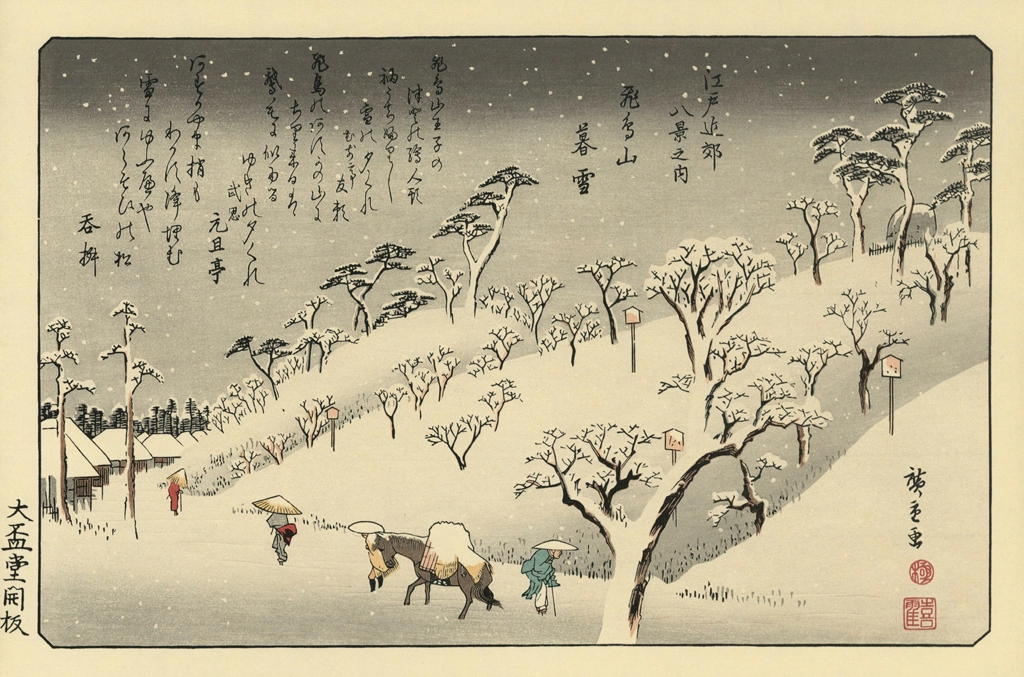
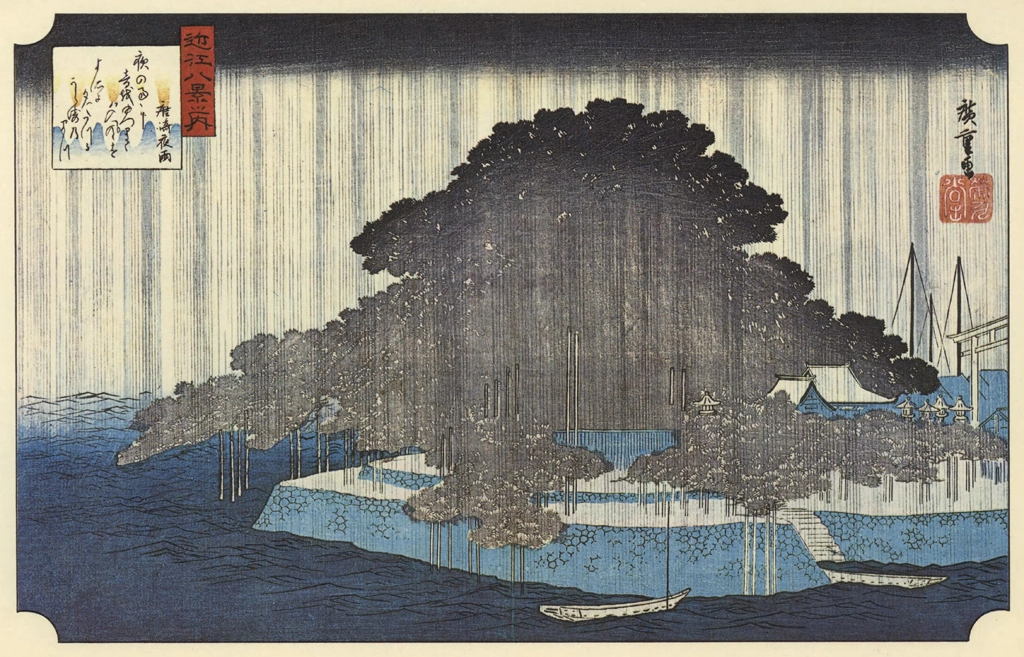
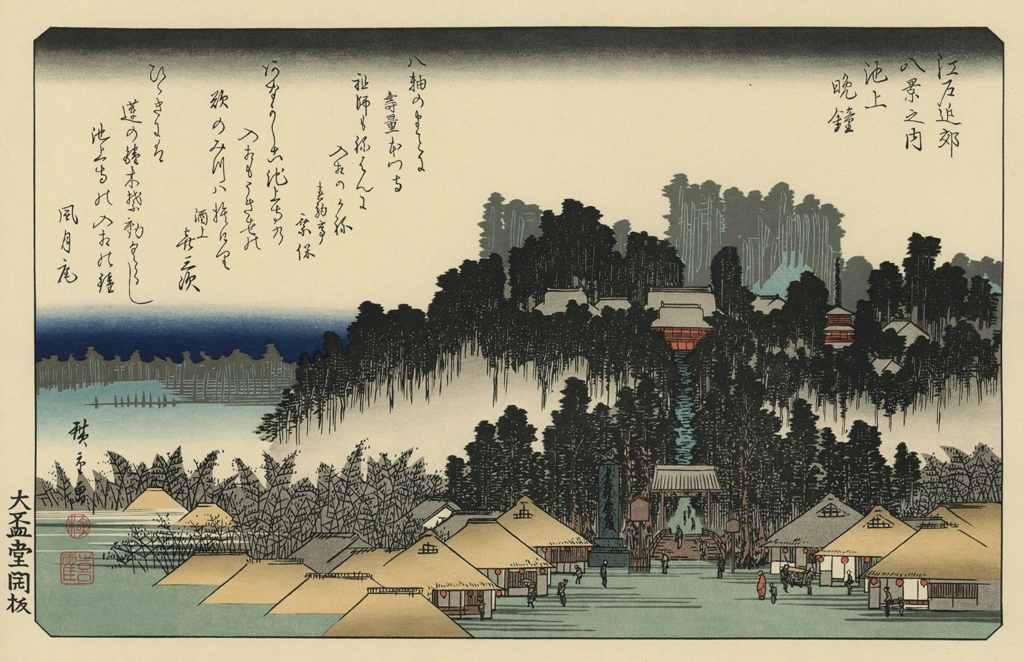
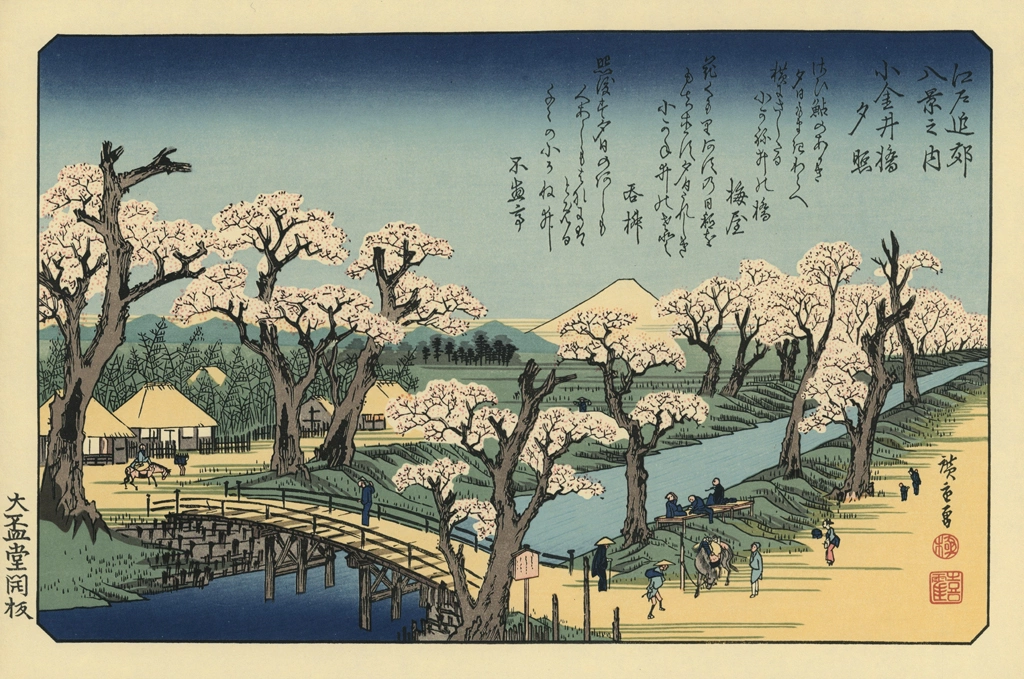
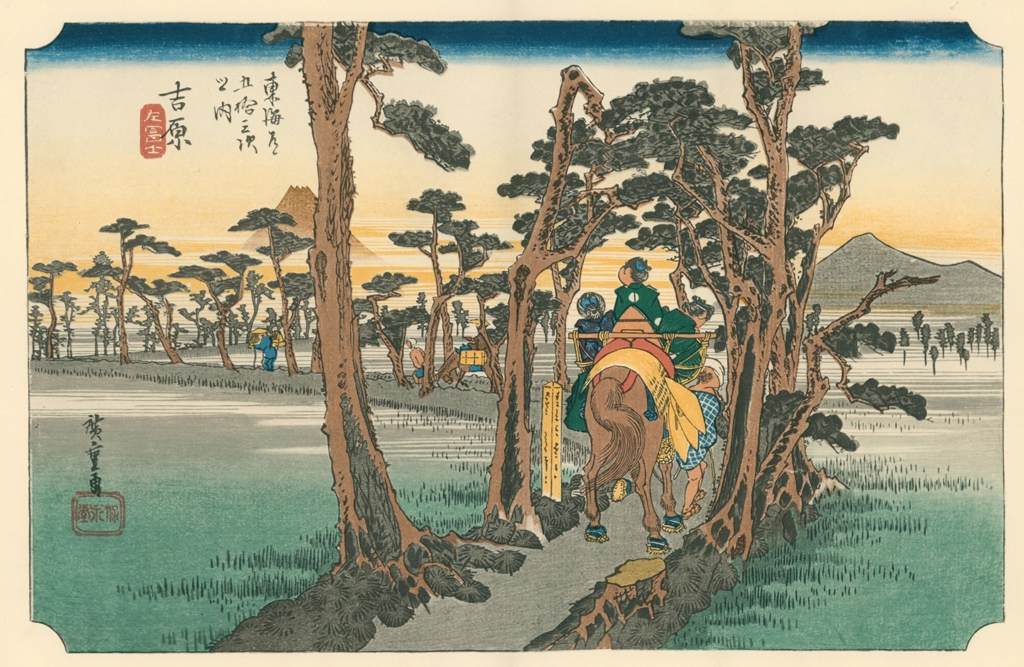
    Utagawa Hiroshige (歌川広重, 1797–1858) is often introduced through The Fifty-Three Stations of the Tōkaidō, and for good reason. The series became one of the most celebrated achievements of ukiyo-e landscape printmaking. Yet Hiroshige’s significance extends far beyond a single famous set of images.

    What makes Hiroshige distinctive is not simply that he depicted well-known places. It is the way he shaped atmosphere. In his prints, rain, mist, snow, evening light, and shifting seasonal conditions are not background details. They are central compositional forces. Familiar roads, bridges, and riverbanks become emotionally charged environments.

    To look at Hiroshige is not only to recognize a place.
    It is to enter a mode of seeing.


    Landscape as Experience, Not Just Topography

    Hiroshige’s prints are often tied to specific locations, stations, routes, and scenic sites. But they rarely function as neutral records. They are carefully structured visual experiences.

    Roads curve and recede. Bridges divide and connect space. Travelers gather, pass, and disappear. Weather alters visibility. Distance becomes something felt rather than merely measured. The viewer’s eye is guided through the image with remarkable control, moving between foreground detail and atmospheric depth.

    This is one reason Hiroshige’s prints remain compelling even when the physical landscapes themselves have changed. Their power lies not only in what they depict, but in how they organize movement, pause, and attention.

    Hiroshige does not simply document place.
    He stages the experience of passing through it.


    Weather as Structure, Not Decoration

    Rain showers, snowfall, haze, wind, twilight, and moonlight are among Hiroshige’s most recognizable motifs. But in his work, weather is not an ornamental effect added to a scene. It is part of the scene’s architecture.

    A slant of rain can energize the entire composition. Mist can flatten distance and dissolve boundaries. Snow can quiet a city and make even crowded places feel hushed. Evening light can soften edges and shift the emotional register of an ordinary route.

    Through these effects, Hiroshige transforms landscape into a medium of feeling without relying on overt drama. A print does not need a climactic event to hold attention. Weather itself becomes the event.

    This quality helps explain why Hiroshige still feels so fresh. His work rewards patient looking. It trains the viewer to notice subtle environmental changes rather than only spectacle.


    Travel Culture and the Expanding Imagination of Place

    Hiroshige worked during a period when roads, travel culture, guidebooks, and famous-place imagery were increasingly important to popular life. Routes such as the Tōkaidō were not only practical infrastructure. They were also cultural and imaginative pathways.

    Prints of stations and scenic points circulated widely. For some viewers, they functioned as souvenirs or visual memories. For others, they offered a form of imagined movement through places they had never visited. A series of prints could create a journey on paper.

    Hiroshige participated in this visual circulation, but he also shaped it. His landscapes did not merely reflect an interest in travel. They helped define what travel felt like visually: the rhythm of departure and arrival, the change of weather across distance, the sense of moving through time as well as space.

    In that sense, Hiroshige’s work belongs to both geography and media culture.


    The Poetics of Everyday Landscape

    One of Hiroshige’s most remarkable achievements is his ability to make ordinary movement through space feel aesthetically meaningful. Roadsides, riverbanks, ferries, bridges, and town edges become worthy of sustained attention.

    This does not mean his landscapes are empty or detached from human life. Human figures are often present, and their small scale is important. They appear as travelers, workers, boatmen, pedestrians, or passing groups. Rather than becoming individualized protagonists, they function as markers of rhythm and relation, helping us sense distance, weather, and terrain.

    The result is a kind of pictorial poetry in which place, season, and motion interweave.

    Hiroshige’s landscapes are not simply views.
    They are temporal scenes, shaped by weather, passage, and the feeling of “in-between.”


    Why Hiroshige Still Feels Contemporary

    Hiroshige’s landscapes continue to resonate because they do not depend on a single heroic event or dramatic climax. Their strength often lies in transitions: a sudden rain shower, fading light, snow settling on a bridge, travelers crossing a road, the pause between departure and arrival.

    In a visual culture saturated with speed and noise, Hiroshige still offers something rare: disciplined attention to atmosphere and a way of seeing place as lived time rather than static scenery.

    That is why Hiroshige remains more than a historical master of landscape prints.
    He remains an artist of perception.

  • Utagawa Kunisada (歌川国貞, 1786–1865)

    Utagawa Kunisada (歌川国貞, 1786–1865) was one of the most commercially successful and visually influential woodblock print artists of late Edo Japan. Yet in many modern introductions to ukiyo-e, he is often mentioned less frequently than Hokusai or Hiroshige. This can create a misleading impression. Kunisada was not a secondary figure. He was one of the central image-makers of urban Edo.

    To understand Kunisada is to understand something essential about the city itself: its theaters, celebrities, fashions, and the visual pleasures of everyday life. His prints did not simply record popular culture. They participated in it, shaped it, and helped define how people saw contemporary style.

    If some ukiyo-e artists are remembered for landscape or heroic drama, Kunisada stands out as a master of people, especially people as they appeared in the circulation of fame, performance, and urban taste.


    The Artist of the Edo Public

    Kunisada worked in a highly competitive print market driven by publishers, audience demand, and fast-moving trends. This was not a slow or isolated art world. It was a bustling visual economy, and Kunisada excelled within it.

    His success was not accidental. He had an exceptional ability to produce images that were immediately appealing while remaining formally skilled and compositionally refined. In this sense, Kunisada’s popularity should not be treated as a sign of lesser artistic value. It is better understood as evidence of his precision within mass culture.

    He knew how to make an image circulate.

    That ability matters. It means that Kunisada’s work gives us direct access not only to artistic technique, but also to how visual desire worked in Edo period society.


    Actor Prints and the Performance of Identity

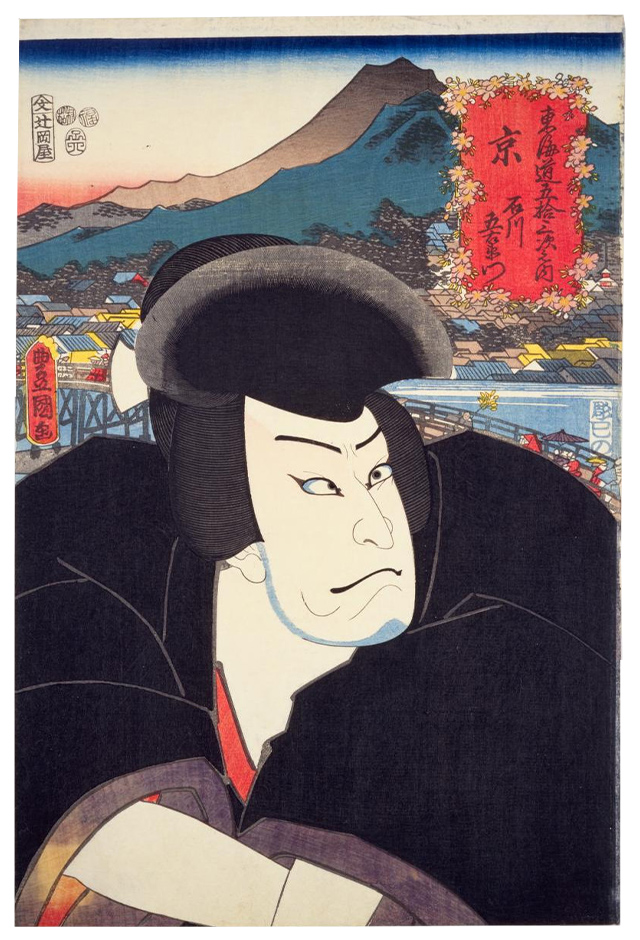
    Kunisada is especially celebrated for his yakusha-e (actor prints), and this is one of the best places to see his strengths clearly.

    Kabuki actors in Edo were not simply performers on a stage. They were public figures, fashion influences, and objects of fan devotion. Actor prints operated somewhere between portraiture, publicity, and performance memory. Kunisada understood this perfectly.

    In his actor prints, costume, pose, facial expression, and gesture carry layered meaning. These are not neutral likenesses. They are images of role-making. An actor is shown not only as an individual person, but as a theatrical presence shaped by character, reputation, and audience expectation.

    This gives Kunisada’s actor prints a fascinating double structure:
    they capture a person, but they also capture a public persona.

    Seen from today, they can feel surprisingly modern. They belong to a media culture in which audiences consumed personality through images, much like celebrity photography, posters, or fan publications in later eras.


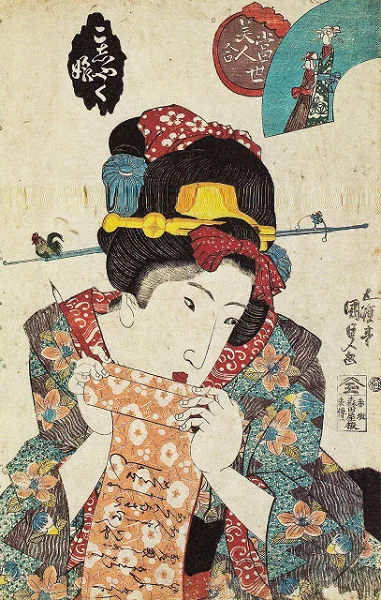
    Beauties, Fashion, and the Language of the Contemporary

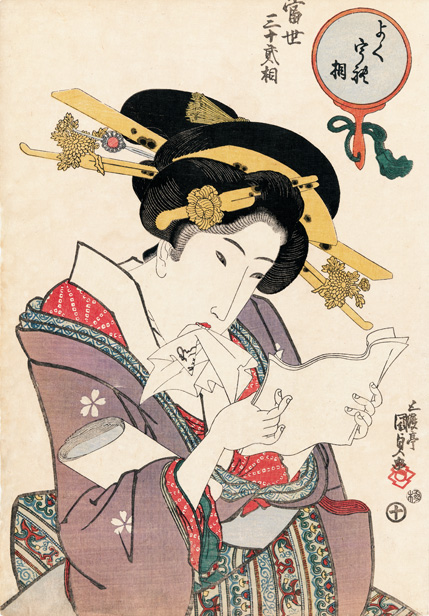
    Kunisada’s bijin-ga (pictures of beauties) reveal another major dimension of his work. Here too, he is not simply producing idealized figures. He is constructing images of social type, mood, and contemporary style.

    Clothing patterns, hair arrangements, accessories, posture, and facial expression all contribute to meaning. These images often preserve the textures of urban life: what looked stylish, what signaled elegance, what seemed current, what circulated as “taste.”

    This is one reason Kunisada remains so valuable for readers of Japanese visual culture. His prints allow us to study not only aesthetics in a narrow sense, but also the coded visual language of everyday modernity within Edo.

    Series such as Thirty-Two Physiognomies are especially compelling in this regard. They suggest that expression itself could be categorized, stylized, and enjoyed as a social and visual type. Kunisada’s interest is not only in beauty, but in how feeling, attitude, and personality become legible on the face.

    In other words, he is an artist of surfaces, but surfaces here are never shallow. They are where social life becomes visible.


    Popularity and Artistic Value

    Kunisada’s huge output has sometimes led to uneven evaluation, especially when viewed through modern habits that privilege singular masterpieces over prolific production. But this framework can obscure what made him important in the first place.

    Kunisada’s achievement lies partly in his ability to sustain quality and invention within a commercial system. He was working in a field shaped by deadlines, publishers, and changing tastes, and he still produced prints of remarkable elegance, clarity, and cultural specificity.

    Rather than asking whether he was “too popular,” a better question may be:
    what kinds of visual intelligence are required to become the artist of a city’s taste?

    Kunisada offers one answer. He demonstrates that artistic significance can emerge not only through radical rupture, but also through deep fluency in the desires and rhythms of contemporary life.


    Why Kunisada Still Matters

    Kunisada’s prints remain powerful because they preserve more than images of actors or beautiful women. They preserve ways of looking. They show how a city recognized fame, admired style, and turned everyday appearance into visual culture.

    If Hiroshige often gives us weather and distance, and Kuniyoshi gives us pressure and dramatic force, Kunisada gives us something equally essential: the social surface of Edo, where identity, fashion, and performance become visible.

    That surface is exactly where much of modern life still happens.
    For that reason, Kunisada does not feel distant. He feels legible.


    Landscape as Experience, Not Just Description

    Hiroshige’s prints are frequently tied to recognizable sites, roads, bridges, stations, and scenic points. But they are rarely just topographical records. They are structured visual experiences.

    Roads curve and recede. Bridges divide and connect space. Travelers gather and disperse. Weather changes what can be seen. Distance becomes part of the composition. The eye is guided through movement, pause, interruption, and release.

    This is one reason Hiroshige’s work remains compelling even when the actual places have changed dramatically. The enduring power of his prints lies not only in location, but in the emotional logic of how a landscape is inhabited, crossed, or remembered.

    He presents place as lived rhythm.


    Weather as Structure

    Rain showers, snowfall, haze, twilight, moonlight, and shifting skies are among Hiroshige’s most recognizable motifs. But in his work, weather is not decorative atmosphere added after the fact. It is structural.

    A diagonal rain pattern can animate an entire image. Mist can flatten depth and soften boundaries. Snow can quiet urban space and transform familiar architecture into a field of stillness. Evening light can slow movement and alter the emotional register of a route.

    Through these effects, Hiroshige turns landscape into a medium of feeling without requiring overt narrative drama. The scene does not need a major event. The weather itself becomes the event.

    This is one reason his prints continue to feel so contemporary. They train attention toward subtle changes in environment rather than only toward spectacle.


    Travel, Media, and the Expanding Imagination of Place

    Hiroshige worked in an era when travel routes, guidebooks, and place imagery were becoming increasingly important to popular culture. Roads such as the Tōkaidō were not only physical infrastructure. They were also visual and imaginative systems.

    Prints of famous places circulated widely. For some viewers, they functioned as souvenirs or visual memories. For others, they offered a form of imagined travel. Even those who did not journey extensively could move through stations, roads, and scenic points through sequences of prints.

    Hiroshige participated in this circulation, but he also shaped it. His prints did not merely reflect an interest in travel. They helped define what travel looked and felt like in visual terms.

    In that sense, his art belongs equally to geography and media culture.


    The Poetics of the Everyday Landscape

    One of Hiroshige’s quiet achievements is his ability to treat ordinary movement through space as aesthetically meaningful. Bridges, riverbanks, roadsides, ferries, and seasonal transitions become worthy of sustained attention.

    This does not mean his landscapes are empty or purely contemplative. Human figures are often present, and their scale matters. They are travelers, workers, passersby, and small markers of life moving through weather and terrain. Yet they are rarely turned into individualized protagonists. Instead, they help establish rhythm, measure, and relational scale.

    The result is a kind of pictorial poetry in which place, season, and motion interweave.

    Hiroshige does not simply show where things are.
    He shows how it feels to move through them.


    Why Hiroshige Still Feels Contemporary

    Hiroshige’s landscapes continue to resonate because they do not depend on a single heroic event or dramatic climax. Their force often lies in transitions: changing weather, passing travelers, fading light, and in-between spaces.

    In a visual culture saturated with speed and noise, Hiroshige’s prints still offer something rare: disciplined attention to atmosphere and a way of seeing place as lived time rather than static scenery.

    That is why Hiroshige remains more than a historical master of famous views.
    He remains an artist of perception.

  • Utagawa Kuniyoshi Exhibition: The Power of a Brilliant Eccentric

    Reading an Edo “Visionary” Through His Art and Human Connections

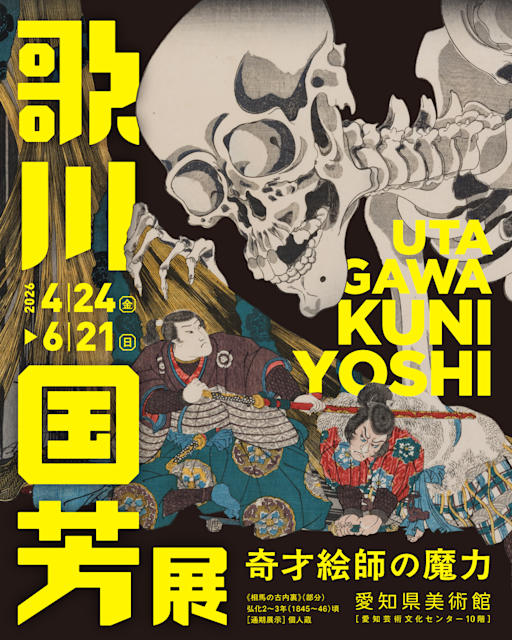
    Opening on April 24, 2026 at the Aichi Prefectural Museum of Art, Utagawa Kuniyoshi Exhibition: The Power of a Brilliant Eccentric is a large-scale exhibition featuring approximately 400 works, offering a rare chance to experience the full range of Kuniyoshi’s art.

    The exhibition is divided into Part I and Part II, with a rotation of works during the run, which means the experience changes depending on when you visit.

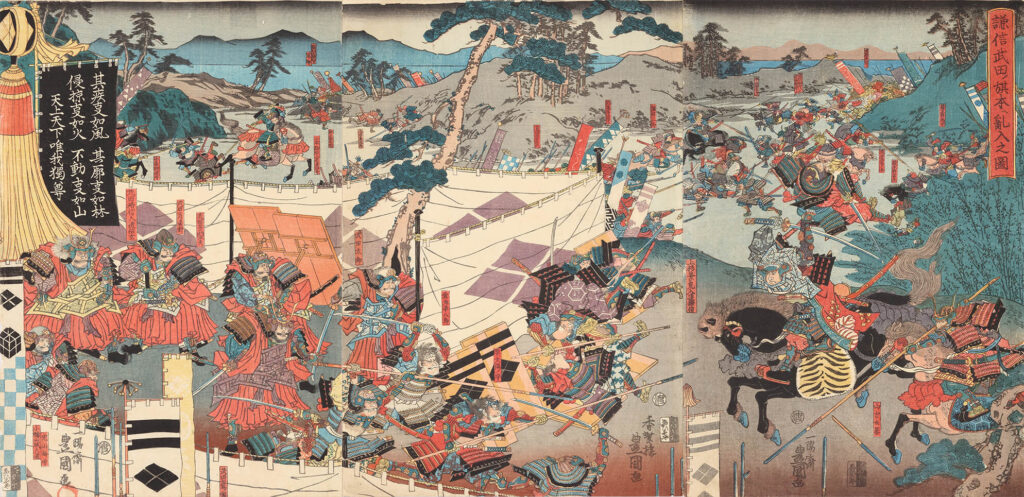
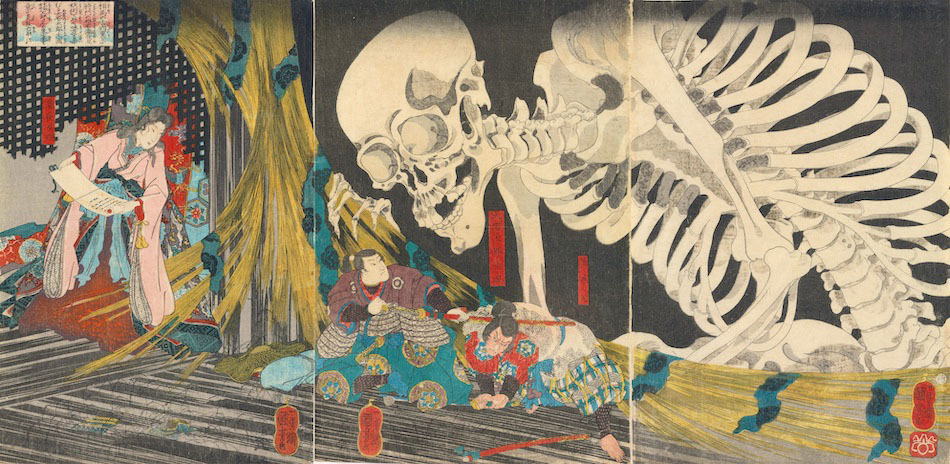
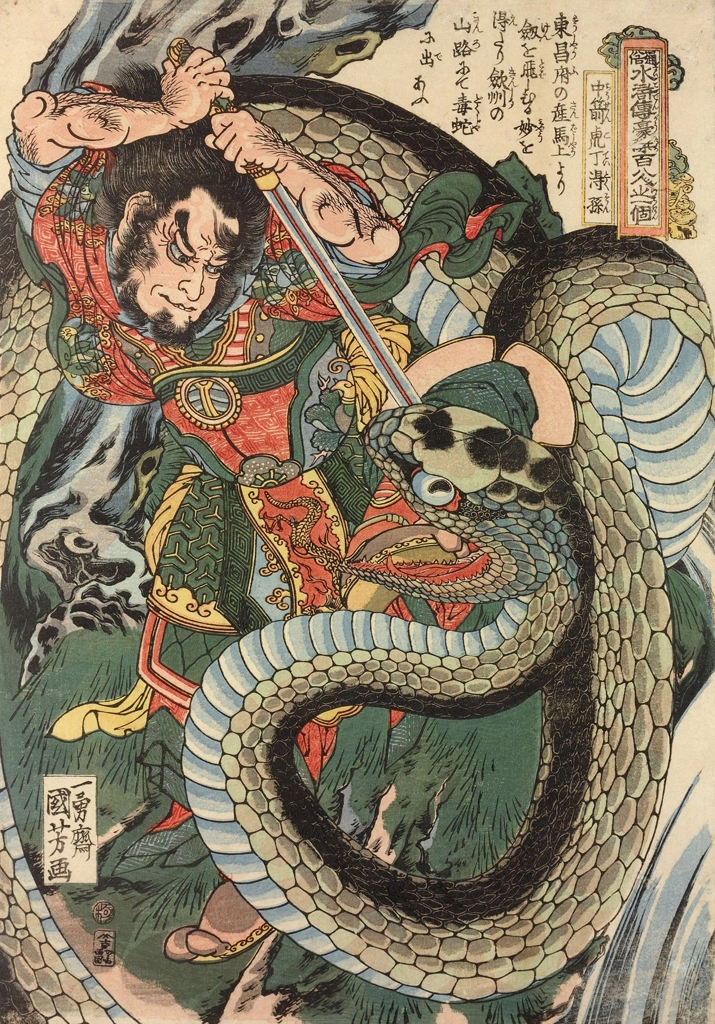
    For many people, Kuniyoshi is immediately associated with striking and unforgettable images, especially works like Takiyasha the Witch and the Skeleton Specter (Sōma no Furudairi), with its famous giant skeleton. But his real fascination goes far beyond visual shock.

    What makes Kuniyoshi truly compelling is this:
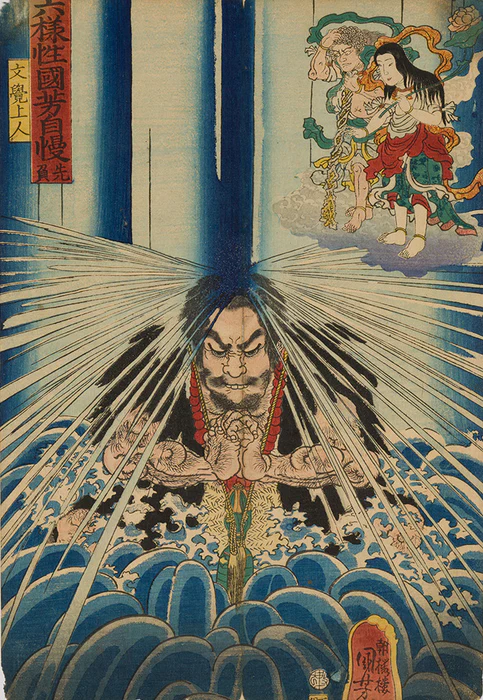
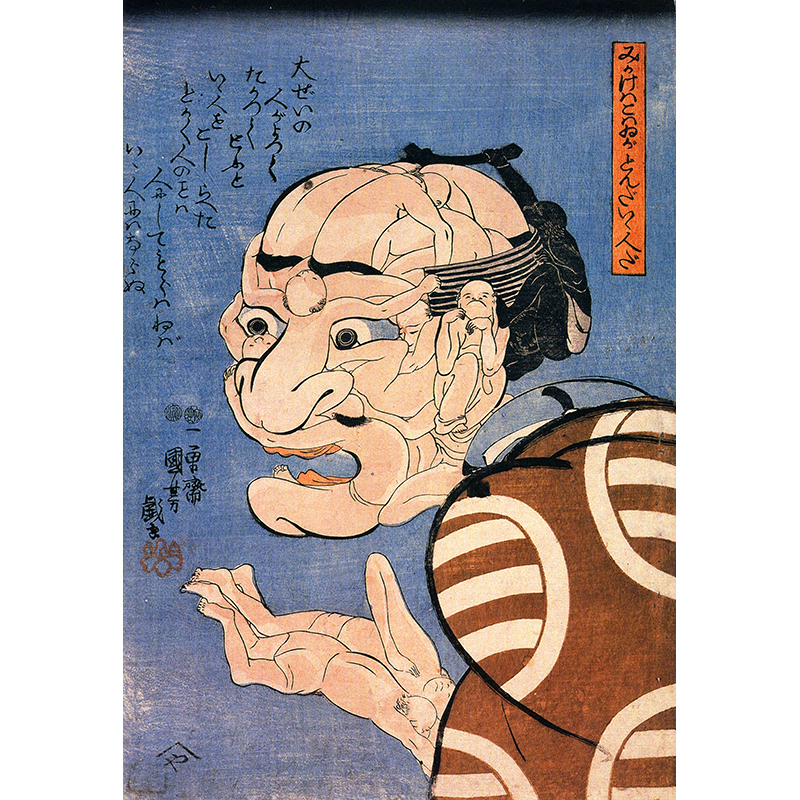
    he could move freely between warrior prints, comic and satirical images, beauties, landscapes, children’s pictures, and actor prints, and still surprise viewers each time from a completely different angle. That flexibility is at the heart of his genius.


    Why Kuniyoshi Still Feels Modern

    1) He Combined Power and Playfulness

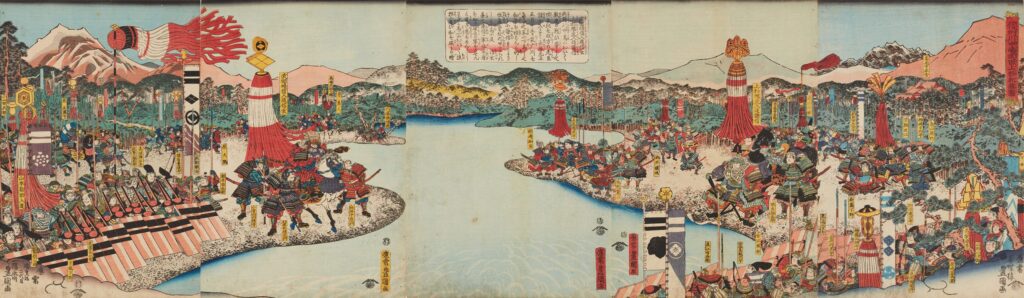
    Kuniyoshi is often remembered as a master of dramatic warrior prints, and rightly so. His heroes are full of motion, tension, and theatrical energy.

    But he was also a brilliant humorist.

    His playful images, including his well-known cat-themed works, reveal an artist who could be witty without losing technical precision. Even when he is joking, the composition is sharp, the linework is controlled, and the design is highly intentional.

    That balance, serious craftsmanship with playful imagination, is one reason Kuniyoshi still feels fresh today. He does not simply “illustrate” a subject. He performs with it.


    2) He Built Images Like a Filmmaker

    Kuniyoshi’s warrior prints and supernatural scenes are not memorable only because they are loud or strange. They work because he knew how to compress narrative into a single frame.

    A Kuniyoshi print often feels like a scene pulled from the middle of a film:
    something has just happened, and something else is about to happen.

    His compositions create momentum. Facial expressions, gestures, diagonals, and layered action all work together to imply story, emotion, and tension beyond the frame.

    That is why a work like Sōma no Furudairi remains iconic. The giant skeleton is visually overwhelming, yes, but the image endures because of its dramatic staging and narrative force.


    3) He Was Not Just a “Genius,” He Was Persistent

    Kuniyoshi’s career was not a smooth ascent from the beginning. He experienced difficult years before achieving major success.

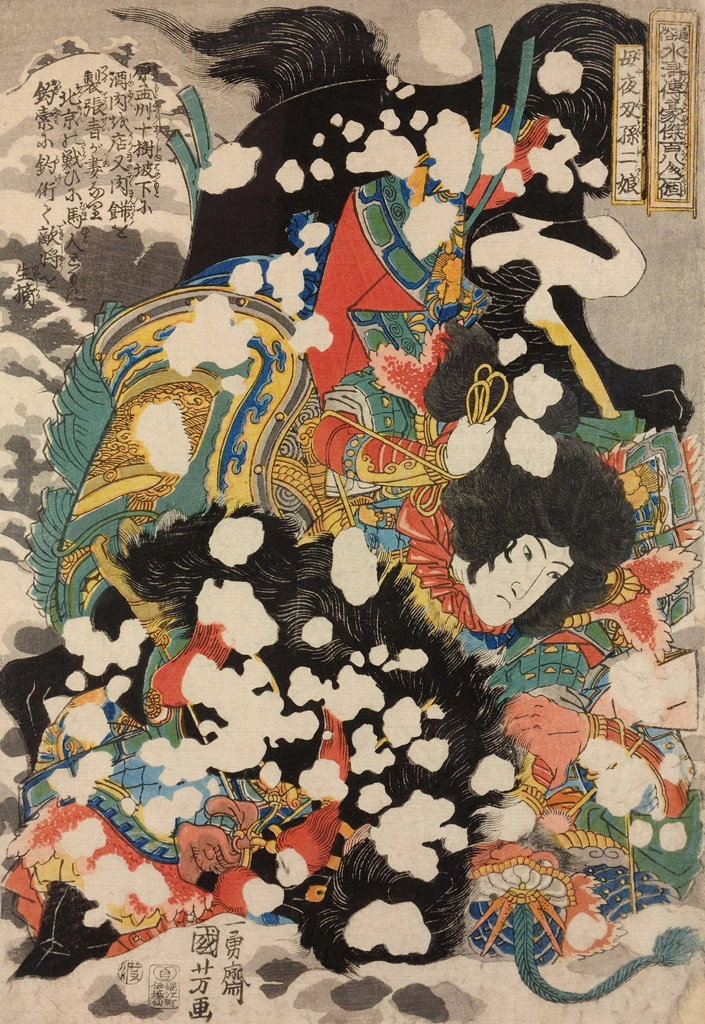
    His breakthrough came in his thirties, especially with the Suikoden hero prints (Tsūzoku Suikoden Gōketsu Hyakuhachinin no Hitori series), which helped establish his reputation.

    This matters because Kuniyoshi’s appeal is not only the sparkle of talent. It is also the resilience of an artist who kept experimenting, refining, and pushing until his style reached the public in a powerful way.

    In other words, he was both visionary and craftsman.


    Kuniyoshi’s Human Network

    Growing, Competing, and Expanding Within the Utagawa School

    To understand Kuniyoshi properly, it helps to place him within the larger world of the Utagawa school, the dominant ukiyo-e network of the late Edo period.

    Kuniyoshi was not working in isolation. He belonged to a huge artistic and commercial ecosystem shaped by publishers, audiences, market trends, and fellow artists.

    Among his contemporaries, Utagawa Kunisada, Utagawa Kuniyoshi, and Utagawa Hiroshige are often grouped as three major figures of the later Utagawa tradition, each excelling in different areas:

    • Kunisada: actor prints and bijin-ga (pictures of beauties), with enormous popular appeal
    • Kuniyoshi: warrior prints, satire, imaginative and unconventional compositions
    • Hiroshige: landscape prints that transformed familiar places into lyrical visual poetry

    Rather than imagining them as a friendly club, it may be more accurate to think of them as top players in the same league. They worked in the same era, within overlapping systems, and their successes likely sharpened each other.

    Seen this way, Kuniyoshi becomes even more interesting. His originality did not emerge outside the mainstream. It emerged inside a highly competitive visual culture.

    Related reading:Utagawa Kunisada (歌川国貞, 1786–1865)

    Related reading:Utagawa Hiroshige (歌川広重, 1797–1858)


    3 Things to Keep in Mind Before Visiting the Exhibition

    1) Look Beyond the Warrior Prints

    Kuniyoshi’s warrior images are essential, but do not stop there. His comic works, landscapes, and genre images reveal how inventive he really was across formats and audiences.

    2) Look for “Time” Inside the Image

    Ask yourself: what just happened, and what is about to happen?
    Kuniyoshi’s best works often feel like suspended drama.

    3) Compare Him to His Contemporaries

    Thinking about Kuniyoshi alongside artists like Kunisada and Hiroshige helps his individuality come into sharper focus.

  • 2026 Sakura Bloom Forecast by Region (Estimated)

    Kyushu — Recommended Cherry Blossom Spots

    Bloom forecast
    • Fukuoka: March 20–23
    • Kagoshima: March 18–21

    Maizuru Park (Fukuoka)
    A former castle site with wide paths and open skies. Easy access from central Fukuoka makes it ideal for casual hanami and first-time visitors.

    Sengan-en (Kagoshima)
    A historic garden with cherry blossoms framed by Sakurajima volcano. A calm, scenic option that blends nature, history, and landscape design.


    Shikoku — Recommended Cherry Blossom Spots

    Bloom forecast
    • Matsuyama: March 22–25
    • Takamatsu: March 23–26

    Matsuyama Castle (Matsuyama)
    Cherry trees climb the hillside around one of Japan’s best-preserved castles. Great views over the city and a classic spring atmosphere.

    Ritsurin Garden (Takamatsu)
    A meticulously designed landscape garden where cherry blossoms appear as part of a larger seasonal composition rather than the main attraction.


    Chugoku — Recommended Cherry Blossom Spots

    Bloom forecast
    • Hiroshima: March 24–27
    • Okayama: March 24–27

    Peace Memorial Park (Hiroshima)
    Rows of cherry trees line the river paths. The contrast between spring blossoms and the site’s historical weight makes for a quiet, reflective hanami.

    Korakuen Garden (Okayama)
    One of Japan’s Three Great Gardens. Cherry blossoms appear alongside ponds, bridges, and open lawns, offering a balanced, elegant setting.


    Kansai — Recommended Cherry Blossom Spots

    Bloom forecast
    • Osaka: March 25–28
    • Kyoto: March 25–29
    • Kobe: March 25–28

    Kema Sakuranomiya Park (Osaka)
    Thousands of cherry trees stretch along the river. Popular, lively, and perfect for walking hanami through the city.

    Philosopher’s Path (Kyoto)
    A narrow canal lined with cherry trees. Best enjoyed early in the morning when the crowds are thin and the mood is quiet.

    Meriken Park (Kobe)
    Cherry blossoms with a modern harbor backdrop. A relaxed, open-space hanami that feels different from traditional park settings.


    Chubu — Recommended Cherry Blossom Spots

    Bloom forecast
    • Nagoya: March 24–27
    • Kanazawa: March 28–April 1
    • Nagano: April 5–10

    Tsuruma Park (Nagoya)
    A classic urban park known for early blooms and night illumination. Popular and energetic during peak season.

    Kanazawa Castle Park (Kanazawa)
    Wide grounds with cherry trees set against castle walls. Spacious and walkable, even during busy weekends.

    Zenkoji Temple (Nagano)
    Late-blooming cherry trees around an important Buddhist temple. A good choice for travelers who miss the peak further south.


    Kanto — Recommended Cherry Blossom Spots

    Bloom forecast
    • Tokyo: March 24–27
    • Yokohama: March 24–27
    • Chiba: March 25–28

    Ueno Park (Tokyo)
    One of Tokyo’s most famous hanami spots. Extremely crowded, festive, and iconic.

    Sankeien Garden (Yokohama)
    A spacious traditional garden with relocated historic buildings. A quieter alternative to central Tokyo parks.

    Chiba Park (Chiba)
    A local favorite with a pond and open lawns. Less tourist traffic, making it suitable for relaxed viewing.


    Tohoku — Recommended Cherry Blossom Spots

    Bloom forecast
    • Sendai: April 4–8
    • Aomori: April 18–22

    Tsutsujigaoka Park (Sendai)
    Known for weeping cherry trees and late-evening illumination. Spacious and calm compared to city-center parks.

    Hirosaki Castle (Aomori)
    One of Japan’s most famous cherry blossom sites. Petals often cover the castle moat like a pink carpet at peak bloom.


    Hokkaido — Recommended Cherry Blossom Spots

    Bloom forecast
    • Sapporo: April 28–May 2
    • Hakodate: April 23–27

    Maruyama Park (Sapporo)
    A natural park beside a shrine, offering a relaxed, local-style hanami experience.

    Goryokaku Park (Hakodate)
    A star-shaped fort surrounded by cherry trees. Famous from above, but equally impressive at ground level.


    Expected Full Bloom Timing

    In most regions, full bloom is expected about one week after the initial bloom:
    • Tokyo / Osaka / Kyoto: late March to early April
    • Tohoku: mid to late April
    • Hokkaido: early May


    Notes
    • These dates are estimates, not guarantees.
    • Warmer-than-average March temperatures may push blooms earlier.
    • Cold snaps can delay blooming by several days.
    • Urban areas tend to bloom slightly earlier than surrounding regions.


    Summary
    • Earliest blooms: Southern Kyushu (mid–late March)
    • Peak nationwide season: Late March to early April
    • Latest blooms: Hokkaido (late April to early May)

    This page will be updated as more precise forecasts become available.

  • Takahashi Shōtei (高橋松亭,1871–1945)

    Takahashi Shōtei (高橋松亭), Edogawa (江戸川), early 20th century.

    This print depicts the Edogawa River, a broad, quiet waterway that once marked the eastern edge of Tokyo. The scene itself is restrained: low horizons, open sky, and a sense of distance rather than drama. But the image becomes more interesting when read through the career of its maker.

    Takahashi Shōtei (高橋松亭, 1871–1945), also known as Hiroaki, was a woodblock print artist active during the late Meiji, Taishō, and early Shōwa periods. He is most closely associated with the shin-hanga movement, which sought to revive traditional ukiyo-e techniques while adapting them to modern tastes and international markets.

    Shōtei trained in Nihonga painting before turning to printmaking, and this background shows in his work. His prints often emphasize atmosphere over narrative, favoring soft light, muted color, and balanced compositions. Unlike earlier ukiyo-e artists who frequently depicted famous places filled with activity, Shōtei’s landscapes are often quiet and sparsely populated, sometimes entirely empty.

    This approach reflects a broader shift in Japanese visual culture during the early twentieth century. Japan was modernizing rapidly, cities were expanding, and everyday landscapes were changing. Rather than documenting spectacle or progress directly, artists like Shōtei often focused on moments of calm—places just before or after human presence, scenes that felt on the verge of disappearance.

    The Edogawa River fits this sensibility well. Historically, it functioned as both a boundary and a connector: a transportation route, a floodplain, and a threshold between urban and rural life. In Shōtei’s hands, it becomes less a specific location than a type of space—open, transitional, and quietly expansive.

    Unlike Katsushika Hokusai or Utagawa Hiroshige, whose river scenes often emphasize movement and rhythm, Shōtei tends toward stillness. Water is flat, skies are wide, and human figures, if present at all, are small and unobtrusive. The viewer is not pulled into a story, but asked to linger.

    This quality made Shōtei’s work particularly popular overseas. Many of his prints were produced for export, and Western collectors responded strongly to their calm, almost meditative tone. Yet it would be misleading to see this only as foreign influence. The attention to atmosphere, weather, and light also connects Shōtei to older Japanese painting traditions, especially landscape screens and seasonal imagery.

    Because of this, Shōtei occupies an ambiguous position in Japanese art history. He is neither fully traditional nor aggressively modern. His work does not announce innovation. Instead, it quietly reframes familiar scenery, presenting it as something worth pausing over.

    In Edogawa, there is no symbolic message spelled out, no dramatic event, and no instruction on how to feel. What remains is a sense of space held open—an image that allows the viewer to rest inside it.

    That quiet openness is characteristic of Takahashi Shōtei’s work as a whole, and it is why his prints continue to feel relevant, even as the landscapes they depict have largely vanished.

  • Katsushika Hokusai (葛飾北斎,1760-1849)

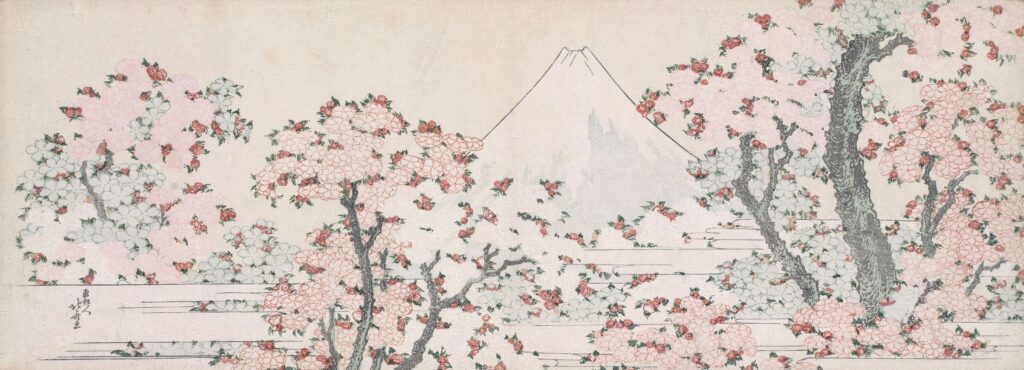
    Katsushika Hokusai (葛飾北斎), Cherry Blossoms and Mount Fuji (桜花に富士図), early 19th century.

    This work is a color woodblock print (nishiki-e), depicting Mount Fuji seen through blooming cherry blossoms. The composition places the viewer slightly below the branches, allowing the mass of blossoms to frame Fuji rather than simply decorate it. The mountain appears stable and distant, while the blossoms dominate the foreground, emphasizing seasonality and impermanence against a symbol of endurance.

    Katsushika Hokusai (葛飾北斎, 1760–1849) was one of the most influential ukiyo-e artists of the Edo period. Active across several decades, he worked in painting, illustration, and woodblock printmaking, producing images that ranged from popular culture to landscapes and instructional manuals. Born in Edo (present-day Tokyo), Hokusai trained in multiple artistic traditions and changed his artist name many times, reflecting both personal reinvention and shifting artistic ambitions.

    Cherry blossoms and Mount Fuji are both deeply familiar motifs in Japanese visual culture, but they function differently. Fuji often represents permanence, stability, and cosmic order. Cherry blossoms, by contrast, are tied to seasonality, transience, and collective experience. In this print, Hokusai does not simply combine two famous symbols; he arranges them so that neither overwhelms the other.

    The blossoms partially obscure Fuji, reminding the viewer that even the most iconic landmark is always encountered through a particular moment, season, and viewpoint. Fuji remains unchanged, but human experience does not. The image quietly emphasizes how perception is shaped by time and circumstance.

    Hokusai’s approach to landscape was innovative for its time. Rather than presenting nature as a distant, idealized backdrop, he often placed the viewer inside the scene, using strong framing elements and unusual angles. This compositional strategy appears here as well: the branches are not decorative borders, but structural components that organize the space and guide the eye.

    As with many ukiyo-e prints, this work was produced for a broad audience rather than elite patrons. Prints like this circulated widely, allowing people to engage with celebrated landscapes without traveling. In that sense, the image participates in a shared visual culture rather than a private or devotional one.

    Because Japanese visual traditions historically blend everyday life, seasonal awareness, and spiritual sensibility, it is not always productive to classify works like this strictly as religious or symbolic. Instead, they can be approached as visual records of how nature, time, and place were commonly perceived and appreciated.

    In Cherry Blossoms and Mount Fuji, Hokusai presents a familiar scene without overt narrative or instruction. The print does not explain itself. It offers a moment of balance: between permanence and change, distance and intimacy, the monumental and the fleeting.

    That restraint is part of its enduring strength.

  • Hanami: The Historical Formation of Cherry Blossom Viewing in Japan

    Hanami, or cherry blossom viewing, is often described as a casual springtime activity in Japan. However, historically, it functioned as a seasonal practice shaped by court culture, agricultural belief, political symbolism, and later, public policy.

    Rather than a single tradition, hanami developed through overlapping layers of meaning that shifted depending on period, social class, and location.


    Early Forms: Flowers and Seasonal Recognition

    The earliest recorded flower-viewing practices in Japan date back to the Nara period (8th century). At this stage, the focus was not cherry blossoms but plum blossoms (ume), which were closely associated with Chinese literary culture and the imperial court.

    These early gatherings emphasized poetry composition and seasonal awareness rather than recreation. Flower viewing functioned as a means of marking time and reinforcing elite cultural identity.

    Cherry blossoms, by contrast, were initially linked to mountain environments and agricultural cycles. In rural belief systems, blooming cherry trees were understood as signs of deities descending from the mountains to oversee rice cultivation.

    Thus, viewing cherry blossoms carried connotations of agricultural forecasting and ritual observation rather than leisure.


    Heian Period: Court Culture and Aestheticization

    During the Heian period, cherry blossoms gradually replaced plum blossoms as the central object of elite seasonal gatherings.

    Court records describe banquets held beneath cherry trees, accompanied by poetry, music, and sake. These events framed cherry blossoms as objects of aesthetic contemplation, but the emphasis remained on temporality rather than permanence.

    Importantly, the flowers were admired precisely because they bloomed briefly. Their short lifespan reinforced a worldview in which seasonal change and impermanence were central organizing principles.


    Warrior Culture and Symbolic Reinterpretation

    From the medieval period onward, cherry blossoms were increasingly adopted within warrior culture.

    Samurai ideology emphasized readiness, sacrifice, and acceptance of death. Cherry blossoms, which fall at their peak rather than withering slowly, became a convenient symbolic reference within this framework.

    This association was not an inherent meaning of the flower itself but a cultural reinterpretation. Cherry blossoms were used as metaphor and ideal rather than as objects of religious devotion.


    Edo Period: Publicization and Institutionalization

    A major shift occurred during the Edo period, when cherry blossom viewing expanded beyond elite circles.

    Authorities actively promoted the planting of cherry trees in public spaces, including riverbanks and temple grounds. These initiatives transformed hanami into a widely accessible seasonal activity.

    Although hanami became more festive during this period, it did not lose its function as a temporal marker. Gatherings still coincided with agricultural calendars and seasonal transitions, even as entertainment elements increased.


    Modern Hanami: Ambiguity as Structure

    In contemporary Japan, hanami resists strict definition.

    Participants may drink alcohol, eat meals, walk quietly, or simply observe. There is no formal doctrine or shared belief required. This lack of prescription is not a weakness but a defining feature.

    Modern hanami operates as an open-ended seasonal practice. Its persistence lies in its flexibility: it allows individuals to project meaning or ignore meaning altogether.


    Continuity Without Doctrine

    Cherry blossoms bloom briefly and fall quickly.
    Afterward, parks are cleaned and daily routines resume.

    Yet hanami returns every year.

    Not as a ritual enforced by belief, but as a socially maintained recognition of seasonal change. It survives not because it demands interpretation, but because it accommodates it.

  • New Year Prayer at Mount Hodo

    Ritual, Mountain Faith, and How It Quietly Continues at Home

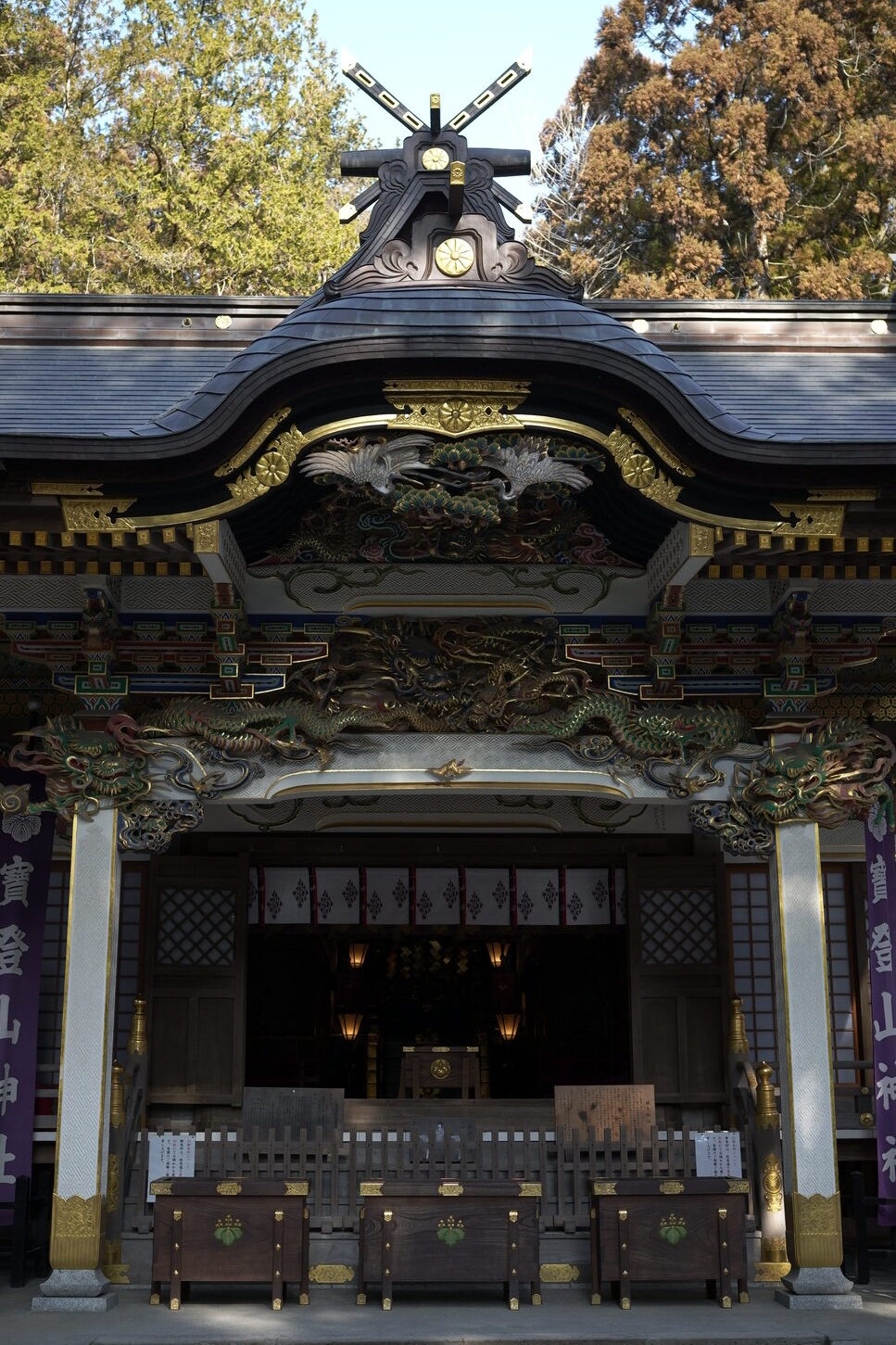
    main shrine (honden)

    At the beginning of the year, I traveled to Chichibu–Nagatoro to take part in New Year prayers and yakuyoke—rites intended to address misfortune and reset one’s position for the year ahead.
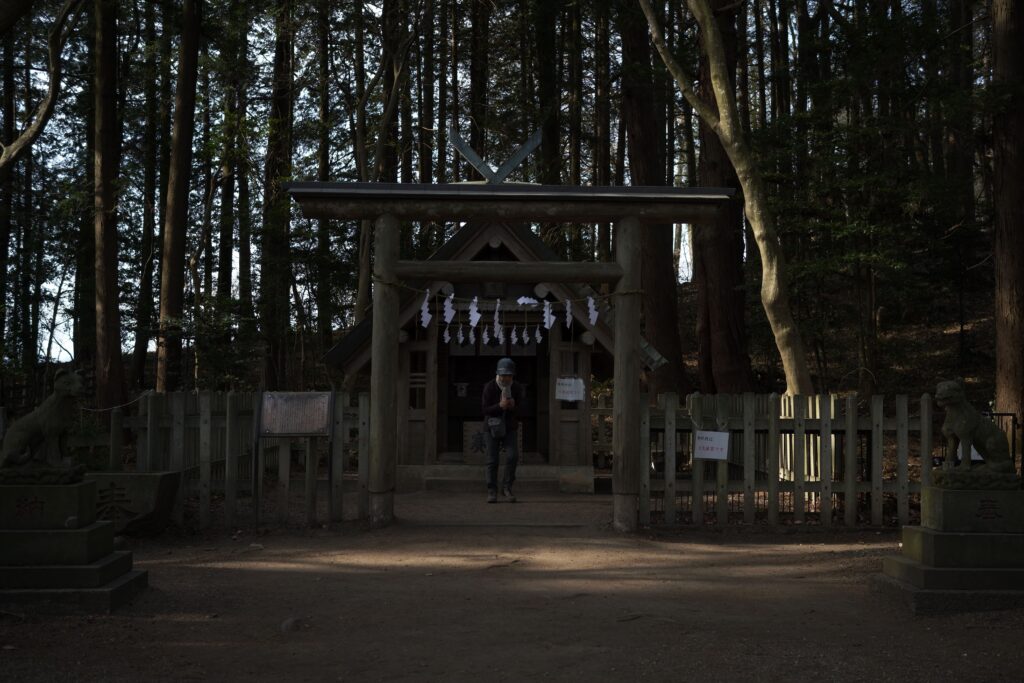
    My destination was Mount Hodo and Hodosan Shrine, a place where mountain belief, local ritual, and everyday life overlap without clear boundaries.

    The visit included prayers at the main shrine (honden), a walk to the inner shrine (okumiya), time at the Inari shrine within the grounds, a climb up the mountain itself, and—later—small, ordinary moments that extended the experience beyond the shrine.


    The main shrine: a ritual remembered by sound

    The yakuyoke ceremony took place at the main shrine.

    What remains most vivid is the sound.

    The deep rhythm of taiko drums filled the space, resonating through the shrine grounds and into the body. The ceremony was neither quiet nor theatrical. It was forceful, repetitive, and immersive, structured by rhythm rather than explanation.

    This ritual carried two meanings at once.

    One was yakuyoke, the removal or deflection of misfortune.
    The other was kenzoku haishaku, the borrowing of divine attendants.

    Rather than asking for protection in an abstract way, the ritual felt like aligning oneself with forces that already exist around the mountain. The drums did not seem to summon something new. They seemed to mark a moment when something was allowed to move closer.

    There was no dramatic promise of safety.
    Instead, it felt like being placed inside a cycle, where danger and protection, wandering and guidance, are always in motion.

    You were not being sealed off from the world.
    You were being given companions for moving through it.


    Okumiya and the mountain as sacred space

    From the main grounds, I continued toward the okumiya, the inner shrine located deeper on Mount Hodo. As one moves away from the entrance, the space gradually shifts. Architecture gives way to terrain.

    Here, worship does not feel confined to a building. The mountain itself becomes part of the shrine. This reflects a broader pattern in Japanese mountain belief, where sacred space expands outward rather than remaining fixed.

    The act of walking matters. Movement through the landscape turns ritual into something physical, preventing it from remaining abstract.


    Wolves and the boundaries of the mountain

    The mountains around Chichibu and Nagatoro were once part of one of Japan’s strongest regions of wolf belief.

    Here, wolves were not primarily seen as dangerous animals.
    They were understood as guardians of the border between the human world and the mountains.

    Wolves lived where villages ended and wilderness began.
    They moved through paths that humans feared to walk at night.
    They appeared in stories not as pets or monsters, but as beings that could sense what did not belong.

    Over time, this practical reality became spiritual language.

    Wolves came to be treated as divine attendants of mountain deities. They protected fields from wild animals, but also protected people from unseen harm. In a place where misfortune was thought to cross into the human world from outside, wolves became figures that stood watch at that crossing.

    This helps explain why yakuyoke rituals feel especially at home in mountain shrines.

    Misfortune is not imagined as something abstract.
    It is something that enters.

    Mountains are where it comes from.
    Wolves are what kept it out.

    Even though the Japanese wolf is now extinct, the shape of that belief remains. Shrines like Mitsumine and the traditions surrounding them preserve the idea that something still guards the boundary, even if it no longer has a physical body.

    Standing on Mount Hodo, it is easy to feel this quietly.

    The forest is close.
    The village is close.
    And between them, something watches.


    Inari within the shrine grounds

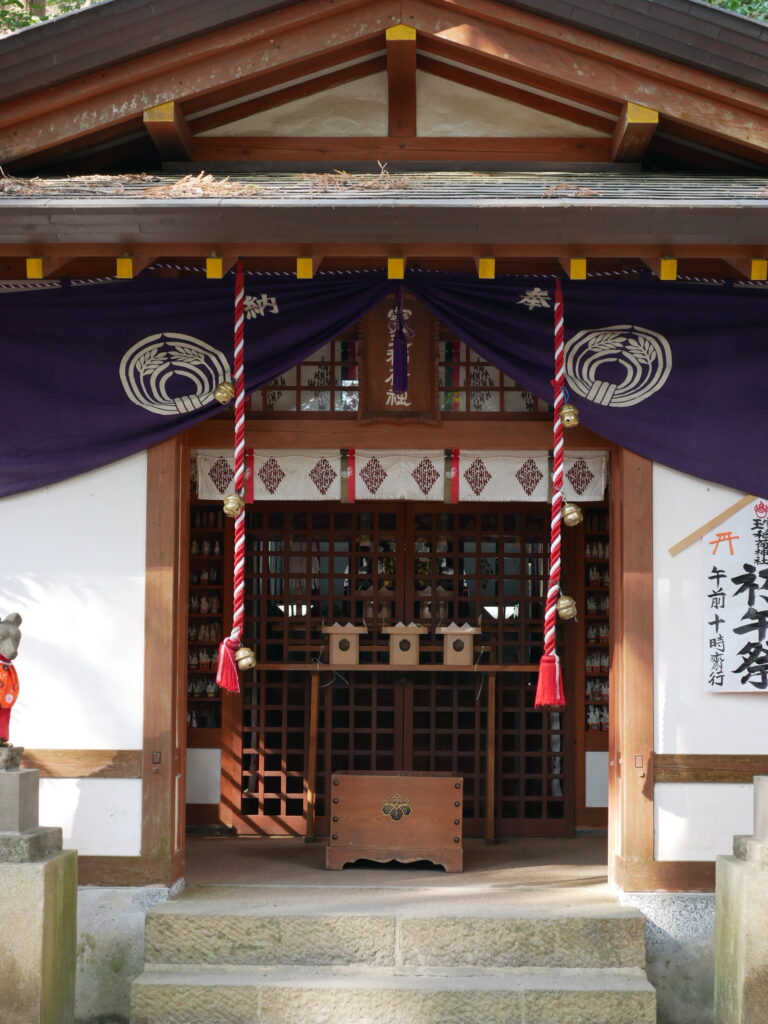
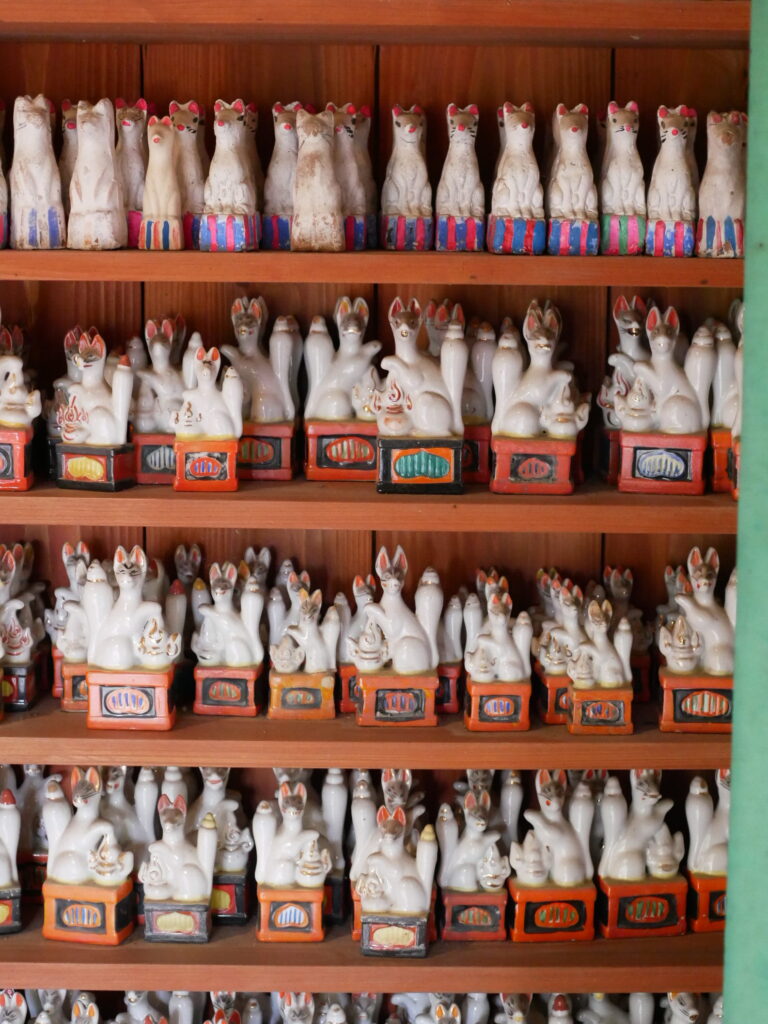
    Within the precincts of Hodosan Shrine, there is also an Inari shrine.

    Inari worship is closely tied to agriculture, food, and livelihood—concerns that are practical, recurring, and ordinary. While mountain deities often relate to boundaries and protection, Inari addresses continuity: harvests, work, and daily sustenance.

    The coexistence of these beliefs is not contradictory. Japanese religious spaces tend to accumulate layers rather than separate them. Protection, provision, and boundary-keeping exist side by side without the need for doctrinal clarity.


    Food after the mountain, and belief continuing quietly

    miso potato

    After descending, I ate miso potato, a simple local snack common in the Chichibu area. Fried potatoes with miso sauce are not refined food, but after walking, they feel exactly right.

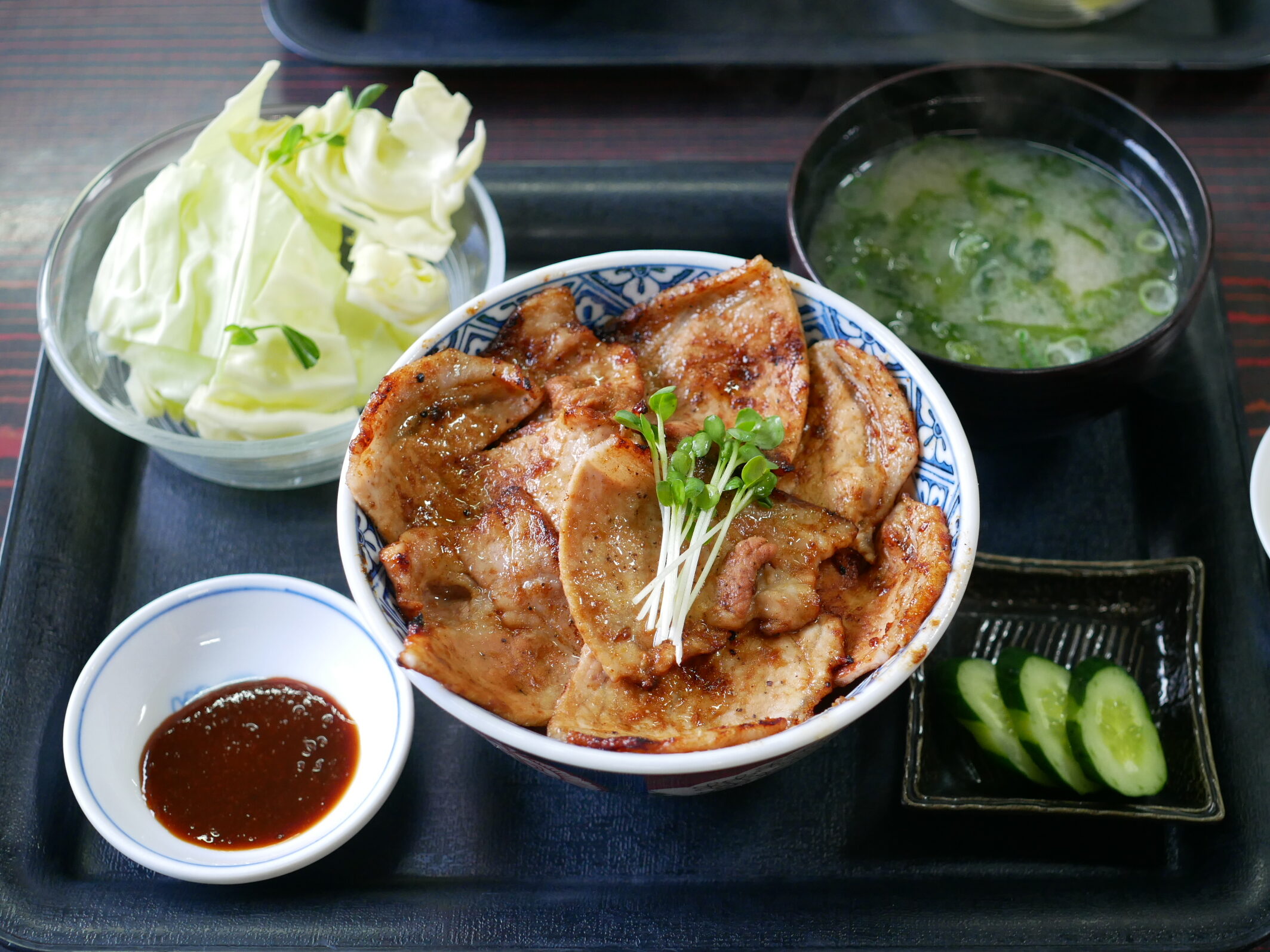
    pork bowl (butadon)

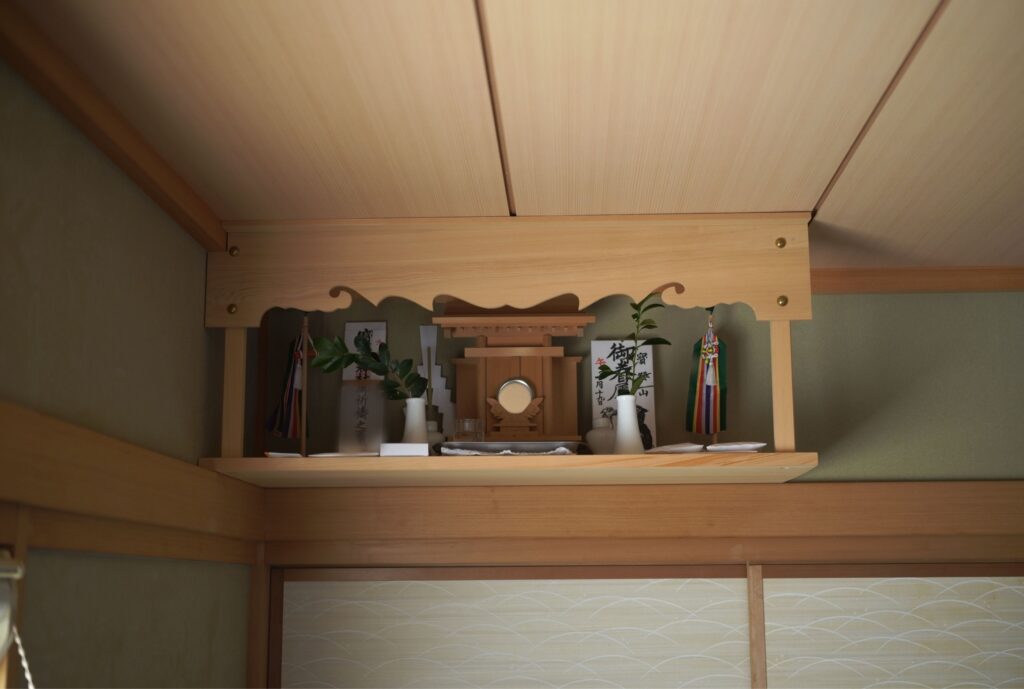
    Later, in Nagatoro, I had lunch at a local yakiniku restaurant and ordered a pork bowl (butadon). Inside the restaurant, there was a kamidana. It enshrined attendants associated with Mitsumine Shrine, another site deeply connected to wolf belief in the region.

    That detail stayed with me.

    Even after leaving the mountain and shrine grounds, the presence of belief continued quietly into an everyday space. Not emphasized, not explained—simply there, above the counter.

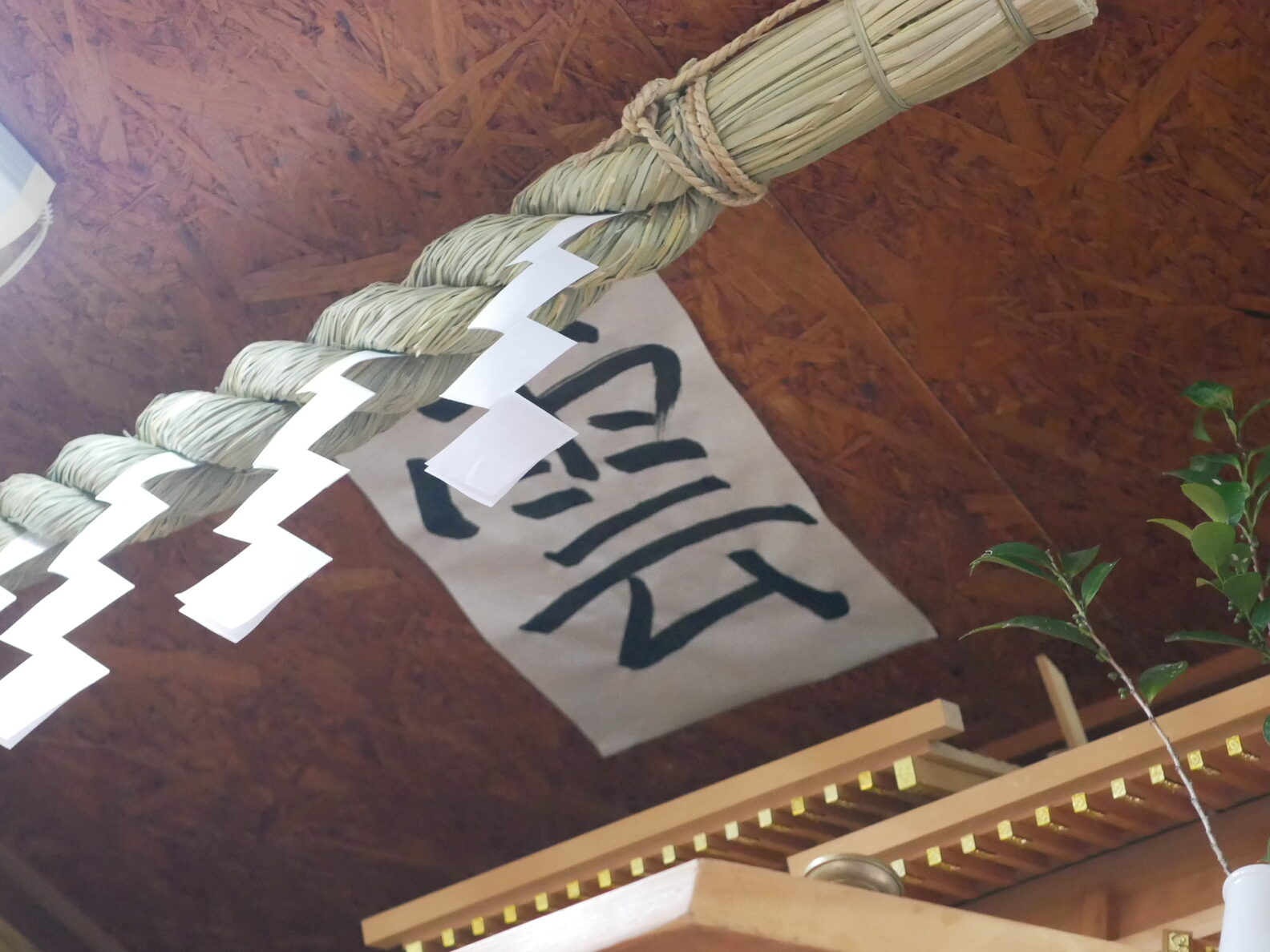
    If you look up at the ceiling directly above the kamidana in this shop, you’ll notice a small sheet of paper with a single character written on it: (“cloud”).

    It’s a quiet marker for something the room can’t physically provide.

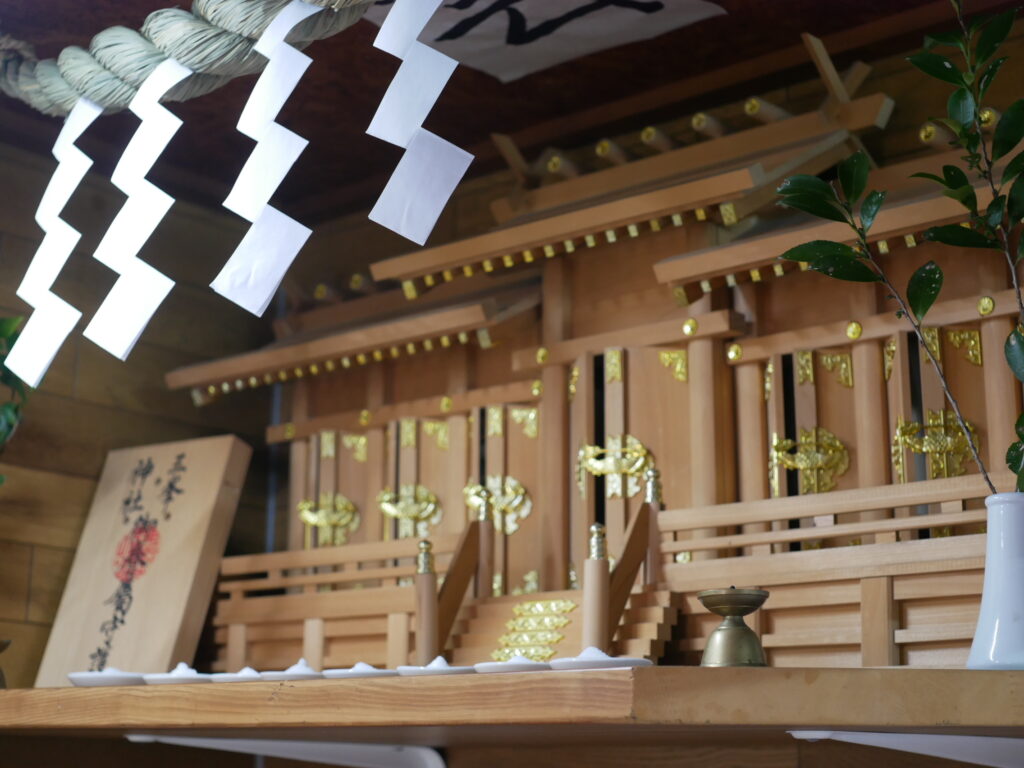
    In many Japanese buildings, the space above a kamidana isn’t open. There may be a second floor, a low ceiling, or solid construction directly overhead. So while the kamidana symbolically points “upward,” the architecture stops that direction short.

    Placing above it is a way of restoring that missing vertical layer.

    A cloud is not the sky itself, but it belongs to the sky. It suggests height, openness, and a world above the ceiling line. In other words, it functions like a small sign that says:

    “From here upward is not just a ceiling. It continues.”

    This is not decoration.
    It is a kind of spatial adjustment.

    It turns the ceiling into something closer to an “upper world,” even if only by imagination and agreement. The kamidana is not simply a miniature shrine inside a room. It is a point that creates a vertical axis in the house, a place where attention and offerings are directed upward.

    Above that point, you can imagine what cannot be built into the structure: distance, elevation, and the unseen realm where gods and their attendants are thought to dwell.

    A single character, , is enough to make that invisible structure feel present.


    Bringing the ritual home: sand, salt, and water

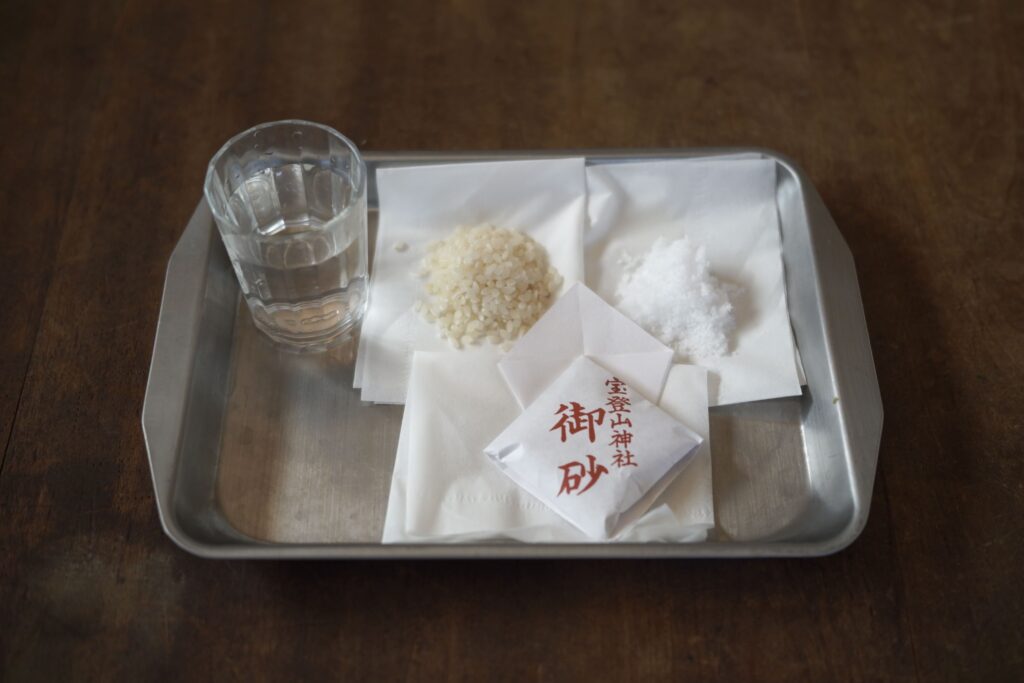
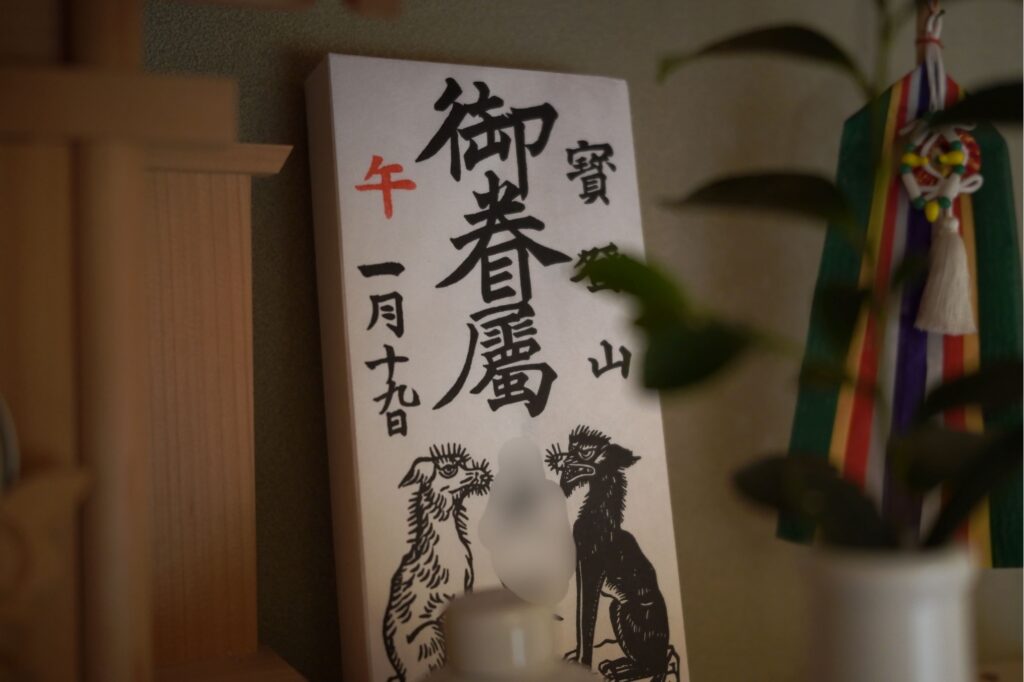
    After the yakuyoke ceremony, I received sand from the shrine.
    This small gesture extended the ritual beyond the shrine grounds.

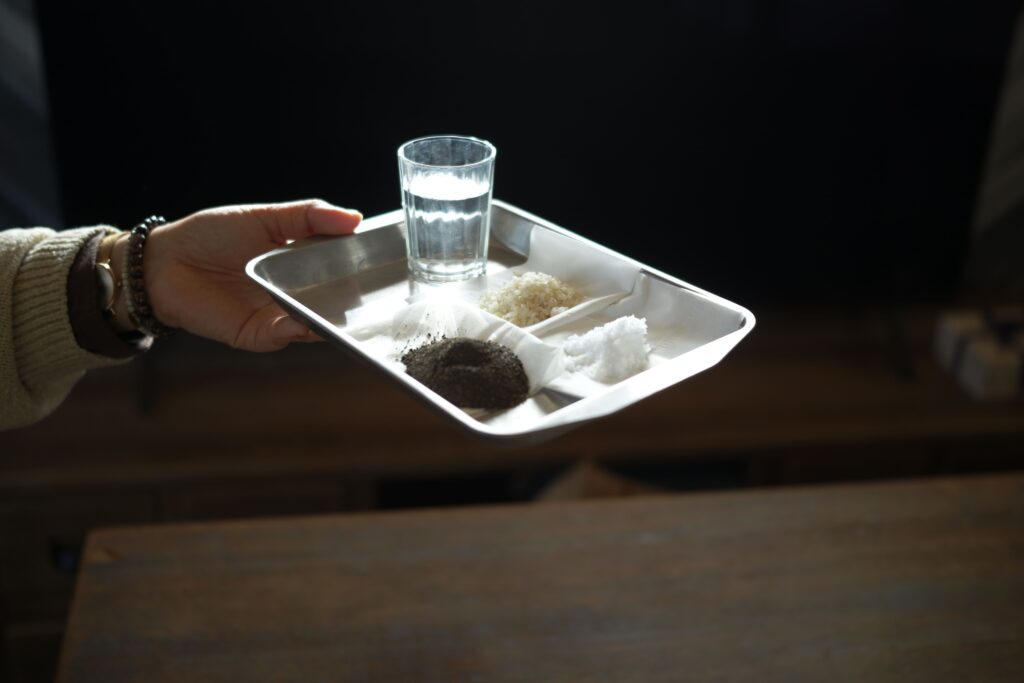
    At home, I placed the sand on the kamidana, together with salt and water.
    Alongside them, I also enshrined the borrowed kenzoku, the divine attendants entrusted during the ritual.

    In this region, those attendants have long been imagined as wolf spirits, quiet guardians of mountains and boundaries.
    The kamidana was no longer just a place for abstract prayer.
    It became a point of contact, a small domestic shrine where something from the mountain was allowed to stay.

    That evening, I took the sand and salt and scattered them at the four outer corners of my home, marking the boundary of the living space.

    The water on the kamidana is replaced and offered for seven consecutive days.

    Nothing dramatic happens during this process. There is no visible change.
    The ritual unfolds through maintenance.

    Sand marks space.
    Salt purifies boundaries.
    Water requires daily attention over time.

    And the wolf kenzoku, quietly enshrined, represent a presence that watches rather than commands.

    Protection here is not imagined as a shield,
    but as something sustained through care, placement, and continued attention.


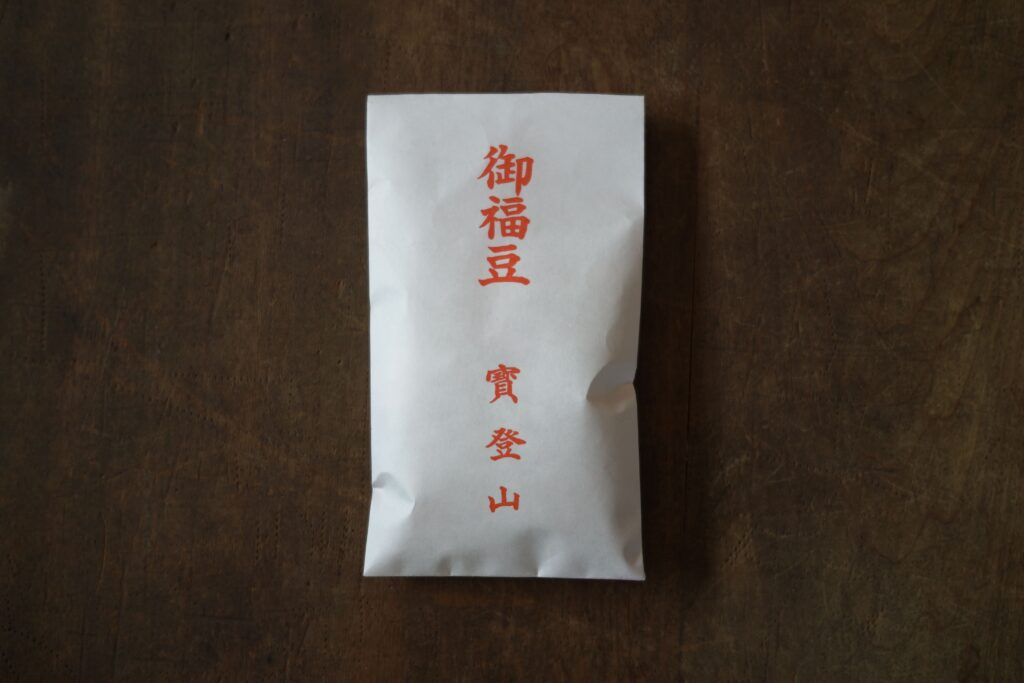
    Setsubun beans
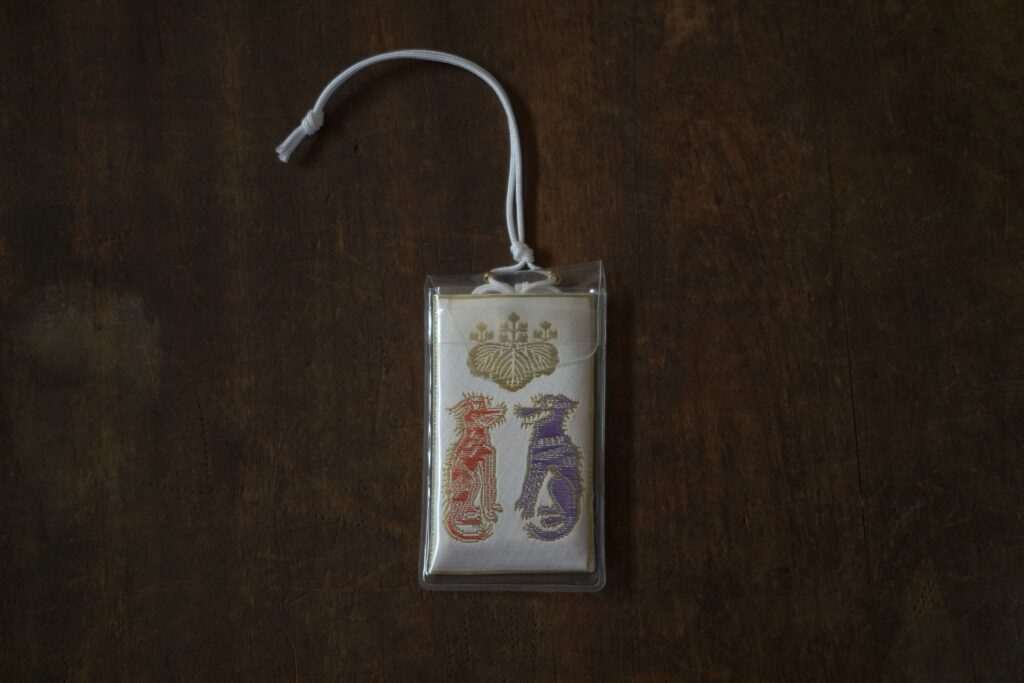
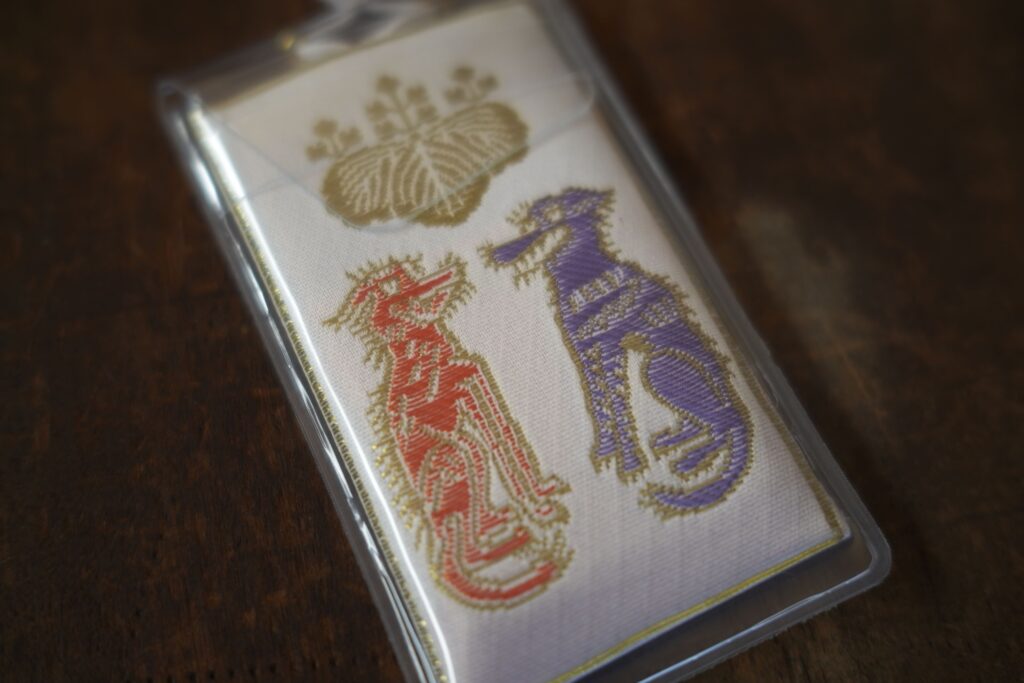
    wolf talisman

    At the end of the visit, I was left with two small objects:
    a packet of Setsubun beans, and a wolf talisman from Hodosan Shrine.

    They are modest in size, almost quiet in their presence.
    But the talisman, in particular, is finely made, with delicate embroidery and a calm, restrained beauty.
    It does not try to impress. It simply is.

    Together, they carry the entire logic of the day.

    The beans mark a seasonal boundary.
    The talisman carries a mountain spirit.
    One resets time.
    The other guards space.

    Long after leaving the shrine, these small, carefully made things continue the ritual quietly, inside ordinary life.