From Honor and Role to Silence and Collapse
Japanese yakuza films are often misunderstood as simple crime movies.
Seen from the outside, they may look like stories of violence, power, or criminal spectacle. Yet historically, the genre functioned very differently. At its core, Japanese yakuza cinema has long been concerned with roles—how individuals are positioned within social structures, what they owe to others, and what happens when those obligations stop making sense.
To understand why yakuza films of the 1970s and 1980s feel quiet, empty, or pessimistic, it is necessary to look backward. The later sense of collapse only becomes meaningful when viewed against the ethical clarity that defined earlier works.
What yakuza films were originally about
Classic yakuza films were not celebrations of lawlessness. They were moral dramas structured around belonging rather than freedom.
The central tension was rarely “how do I win?” but rather:
- Who do I answer to?
- What obligations have I inherited?
- How do I act correctly when duties collide?
This logic distinguishes Japanese yakuza films from many Western gangster narratives. Where Western crime films often emphasize ambition, ascent, or rebellion, Japanese yakuza films traditionally emphasized position—a fixed place within a hierarchy that defines one’s responsibilities.
For much of the genre’s early history, that position still carried meaning.
The ethical foundation: 1950s–1960s yakuza films
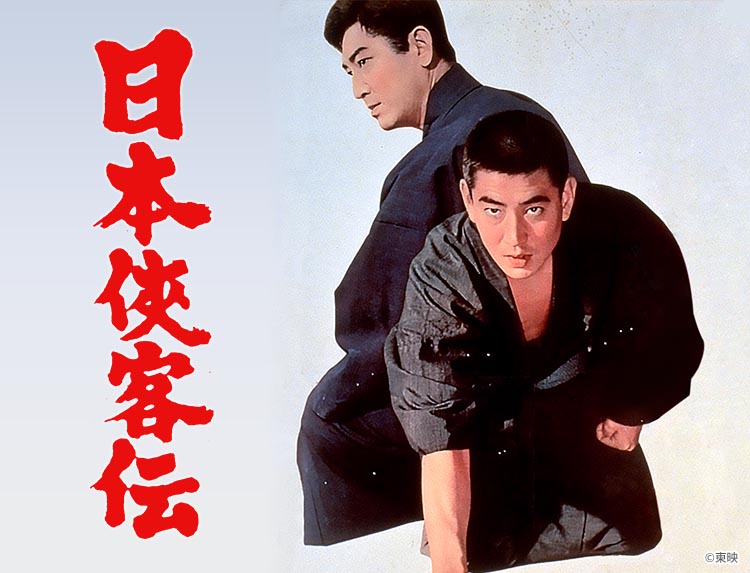
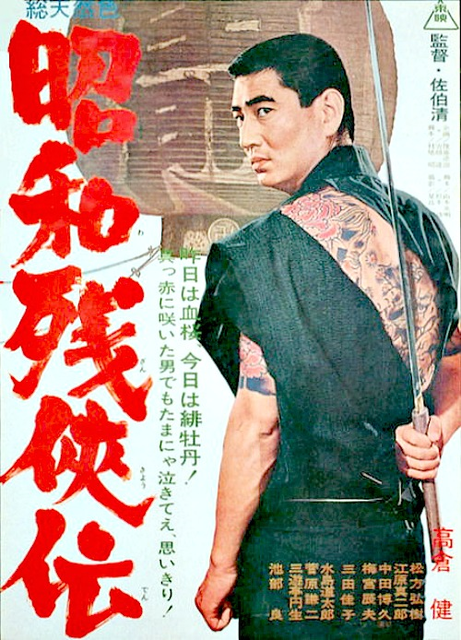
In the 1950s and 1960s, yakuza cinema developed in close parallel with postwar Japanese society. This period is often described by scholars as the era of ninkyō eiga (chivalry films), in which yakuza figures were portrayed as bearers of an idealized moral code.
These films did not aim for sociological realism. Instead, they presented yakuza protagonists as symbolic figures who embodied values such as:
- loyalty to one’s group,
- self-restraint,
- and willingness to sacrifice personal happiness for obligation.
Importantly, these stories often ended tragically. Acting honorably did not guarantee survival or success. However, the films affirmed that ethical consistency itself had value, even in defeat.
This worldview reflected a broader postwar emphasis on social roles, discipline, and endurance—values that also structured corporate and communal life during Japan’s reconstruction period.
(→ See: Early Japanese Yakuza Films: Honor, Duty, and the Birth of a Genre)
Repetition as reassurance
Early yakuza films frequently repeated similar plots, character types, and emotional arcs. Far from weakening the genre, this repetition functioned as ritual.
Audiences were not primarily seeking surprise. They were watching to confirm that, despite hardship and loss, there was still a correct way to act. The films offered emotional reassurance during a period of rapid social transformation by asserting that moral order, though costly, remained intelligible.
This stability would not last.
The rupture of the 1970s

Used for commentary and critical discussion purposes.
By the early 1970s, the assumptions underlying the genre began to fracture. Economic growth, urbanization, and changes in labor structures increasingly exposed the gap between cinematic codes and lived reality.
The decisive break comes with 仁義なき戦い (1973).
Rather than portraying yakuza as tragic moral figures, the series presents a world in which:
- loyalty is transactional,
- violence is chaotic rather than ritualized,
- and ethical codes collapse under pressure.
What distinguishes this shift is not merely its depiction of brutality, but its conclusion: the old heroic framework no longer functions. Honor does not organize behavior. Obligation no longer stabilizes identity.
From this point onward, yakuza films stop asking how to live honorably and begin asking whether honor itself has any social foundation left.
Why the 1980s feel especially bleak
The pessimism of 1980s yakuza cinema is often misunderstood as a reaction to hardship. In fact, it emerges during a period of relative economic stability.
This paradox is crucial. By the 1980s, the social promise that once justified sacrifice—loyalty to an organization, endurance within a role—had begun to erode. Long-term belonging no longer guaranteed security or meaning.
Yakuza films respond by hollowing out their protagonists.
Typical figures of the era are:
- isolated rather than authoritative,
- burdened by past decisions,
- aware that their inherited roles no longer connect to a coherent moral order.
They do not fight to achieve resolution. They persist, hesitate, or quietly fail.
Silence instead of spectacle
Used for commentary and critical discussion purposes.
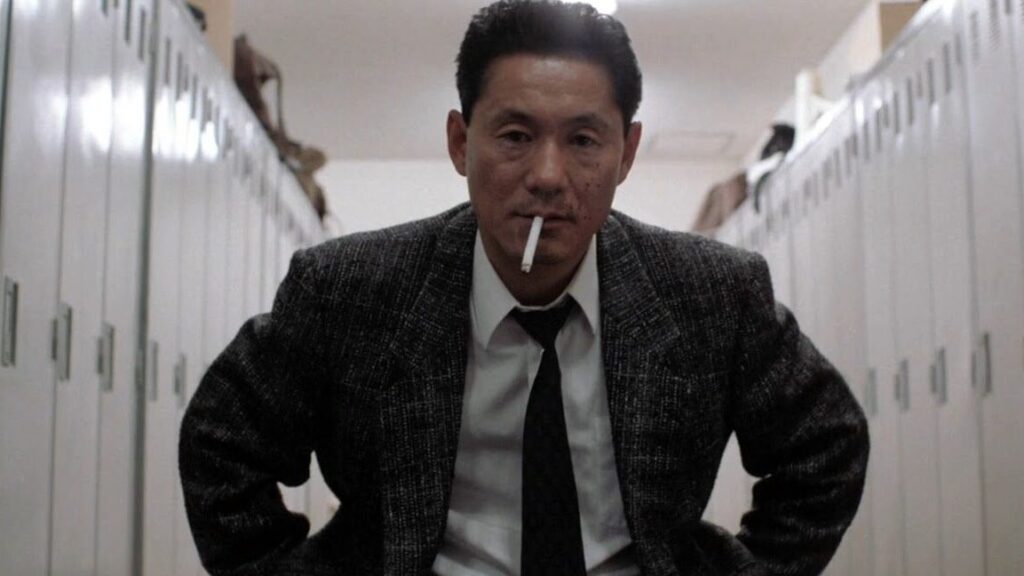
This transformation is especially clear in その男、凶暴につき (1989).
Violence here is abrupt and largely unexplained. Emotional framing is minimal. Scenes unfold with long pauses and limited dialogue. The film does not guide the viewer toward moral judgment.
What makes the film unsettling is not its brutality, but its ethical emptiness. The protagonist cannot articulate his role within any stable system. Authority figures provide no guidance. Violence becomes an action without justification.
This stylistic restraint reflects a broader late-1980s tendency in Japanese cinema, where silence functions not as elegance but as structural absence.
Shifting perspectives: seeing the system’s effects
Used for commentary and critical discussion purposes.
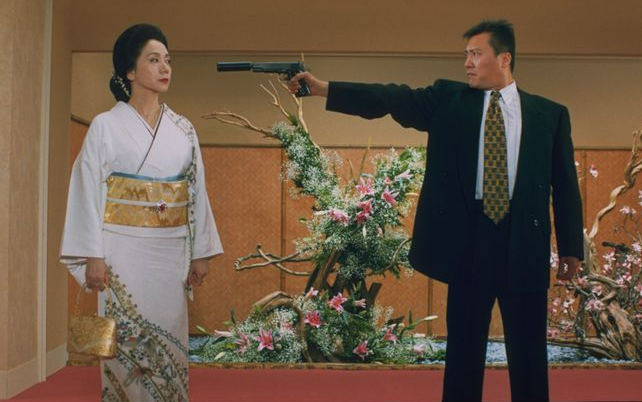
Another important development of the 1980s is a change in vantage point. Films such as 極道の妻たち (1986) examine the yakuza world from perspectives previously marginalized.
Here, the organization is no longer romanticized as a brotherhood. It appears as a rigid, male-centered structure that distributes harm outward. Loyalty is not chosen; it is imposed.
This shift reveals something essential: the yakuza code is no longer questioned only from within. Its consequences become visible in everyday life.
Stagnation and return

Used for commentary and critical discussion purposes.
A quieter but equally telling example is 夜叉 (1985).
Set in an isolated environment, the film centers on characters unable to escape their past affiliations. Conflict arises not from ambition but from inertia. Identity hardens into fate.
Here, yakuza affiliation resembles a lingering condition rather than a chosen path. Violence is repetitive, drained of symbolic meaning. The genre’s earlier sense of tragic dignity has evaporated.
What collapses on screen
Across these films, what collapses is not morality itself, but the assumption that belonging provides meaning.
Earlier yakuza cinema assumed that suffering within a role had value. By the 1980s, this assumption no longer holds. Loyalty does not protect. Tradition does not stabilize identity. Violence fails to resolve ethical tension.
What remains is silence, routine, and the weight of commitments made under outdated premises.
Why this history still matters
Japanese yakuza films chart a cultural arc rather than a genre gimmick. They document how a society’s ethical imagination changes over time.
The emptiness of later films is not accidental. It gains force precisely because earlier works once offered clarity, structure, and purpose. Collapse only resonates when something meaningful once stood in its place.
Seen this way, yakuza cinema is less about crime than about how societies outgrow their own moral frameworks—and what happens to those left behind inside them.