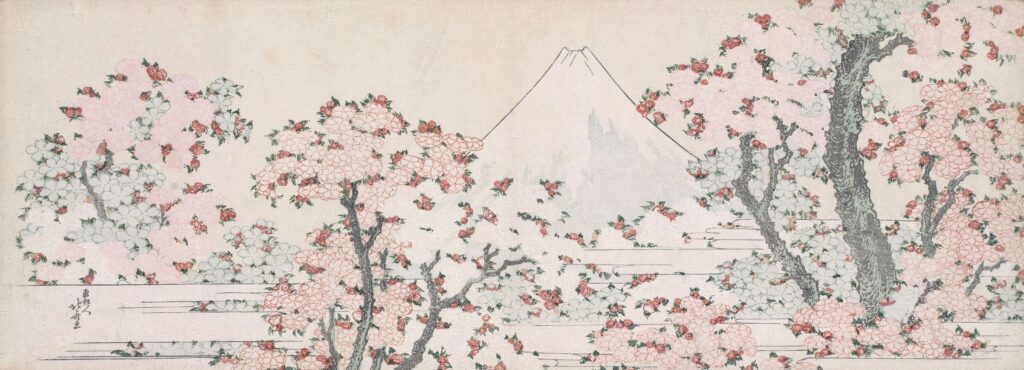
This work is a color woodblock print (nishiki-e), depicting Mount Fuji seen through blooming cherry blossoms. The composition places the viewer slightly below the branches, allowing the mass of blossoms to frame Fuji rather than simply decorate it. The mountain appears stable and distant, while the blossoms dominate the foreground, emphasizing seasonality and impermanence against a symbol of endurance.
Katsushika Hokusai (葛飾北斎, 1760–1849) was one of the most influential ukiyo-e artists of the Edo period. Active across several decades, he worked in painting, illustration, and woodblock printmaking, producing images that ranged from popular culture to landscapes and instructional manuals. Born in Edo (present-day Tokyo), Hokusai trained in multiple artistic traditions and changed his artist name many times, reflecting both personal reinvention and shifting artistic ambitions.
Cherry blossoms and Mount Fuji are both deeply familiar motifs in Japanese visual culture, but they function differently. Fuji often represents permanence, stability, and cosmic order. Cherry blossoms, by contrast, are tied to seasonality, transience, and collective experience. In this print, Hokusai does not simply combine two famous symbols; he arranges them so that neither overwhelms the other.
The blossoms partially obscure Fuji, reminding the viewer that even the most iconic landmark is always encountered through a particular moment, season, and viewpoint. Fuji remains unchanged, but human experience does not. The image quietly emphasizes how perception is shaped by time and circumstance.
Hokusai’s approach to landscape was innovative for its time. Rather than presenting nature as a distant, idealized backdrop, he often placed the viewer inside the scene, using strong framing elements and unusual angles. This compositional strategy appears here as well: the branches are not decorative borders, but structural components that organize the space and guide the eye.
As with many ukiyo-e prints, this work was produced for a broad audience rather than elite patrons. Prints like this circulated widely, allowing people to engage with celebrated landscapes without traveling. In that sense, the image participates in a shared visual culture rather than a private or devotional one.
Because Japanese visual traditions historically blend everyday life, seasonal awareness, and spiritual sensibility, it is not always productive to classify works like this strictly as religious or symbolic. Instead, they can be approached as visual records of how nature, time, and place were commonly perceived and appreciated.
In Cherry Blossoms and Mount Fuji, Hokusai presents a familiar scene without overt narrative or instruction. The print does not explain itself. It offers a moment of balance: between permanence and change, distance and intimacy, the monumental and the fleeting.
That restraint is part of its enduring strength.
Leave a Reply