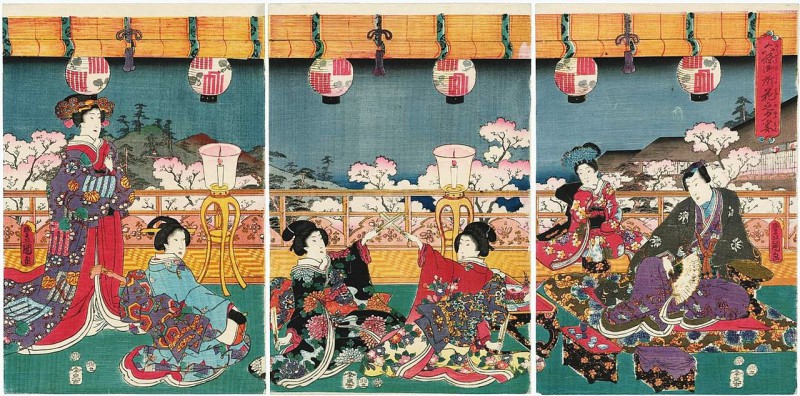
Hanami, or cherry blossom viewing, is often described as a casual springtime activity in Japan. However, historically, it functioned as a seasonal practice shaped by court culture, agricultural belief, political symbolism, and later, public policy.
Rather than a single tradition, hanami developed through overlapping layers of meaning that shifted depending on period, social class, and location.
Early Forms: Flowers and Seasonal Recognition
The earliest recorded flower-viewing practices in Japan date back to the Nara period (8th century). At this stage, the focus was not cherry blossoms but plum blossoms (ume), which were closely associated with Chinese literary culture and the imperial court.
These early gatherings emphasized poetry composition and seasonal awareness rather than recreation. Flower viewing functioned as a means of marking time and reinforcing elite cultural identity.
Cherry blossoms, by contrast, were initially linked to mountain environments and agricultural cycles. In rural belief systems, blooming cherry trees were understood as signs of deities descending from the mountains to oversee rice cultivation.
Thus, viewing cherry blossoms carried connotations of agricultural forecasting and ritual observation rather than leisure.
Heian Period: Court Culture and Aestheticization
During the Heian period, cherry blossoms gradually replaced plum blossoms as the central object of elite seasonal gatherings.
Court records describe banquets held beneath cherry trees, accompanied by poetry, music, and sake. These events framed cherry blossoms as objects of aesthetic contemplation, but the emphasis remained on temporality rather than permanence.
Importantly, the flowers were admired precisely because they bloomed briefly. Their short lifespan reinforced a worldview in which seasonal change and impermanence were central organizing principles.
Warrior Culture and Symbolic Reinterpretation
From the medieval period onward, cherry blossoms were increasingly adopted within warrior culture.
Samurai ideology emphasized readiness, sacrifice, and acceptance of death. Cherry blossoms, which fall at their peak rather than withering slowly, became a convenient symbolic reference within this framework.
This association was not an inherent meaning of the flower itself but a cultural reinterpretation. Cherry blossoms were used as metaphor and ideal rather than as objects of religious devotion.
Edo Period: Publicization and Institutionalization
A major shift occurred during the Edo period, when cherry blossom viewing expanded beyond elite circles.
Authorities actively promoted the planting of cherry trees in public spaces, including riverbanks and temple grounds. These initiatives transformed hanami into a widely accessible seasonal activity.
Although hanami became more festive during this period, it did not lose its function as a temporal marker. Gatherings still coincided with agricultural calendars and seasonal transitions, even as entertainment elements increased.
Modern Hanami: Ambiguity as Structure
In contemporary Japan, hanami resists strict definition.
Participants may drink alcohol, eat meals, walk quietly, or simply observe. There is no formal doctrine or shared belief required. This lack of prescription is not a weakness but a defining feature.
Modern hanami operates as an open-ended seasonal practice. Its persistence lies in its flexibility: it allows individuals to project meaning or ignore meaning altogether.
Continuity Without Doctrine
Cherry blossoms bloom briefly and fall quickly.
Afterward, parks are cleaned and daily routines resume.
Yet hanami returns every year.
Not as a ritual enforced by belief, but as a socially maintained recognition of seasonal change. It survives not because it demands interpretation, but because it accommodates it.
Leave a Reply