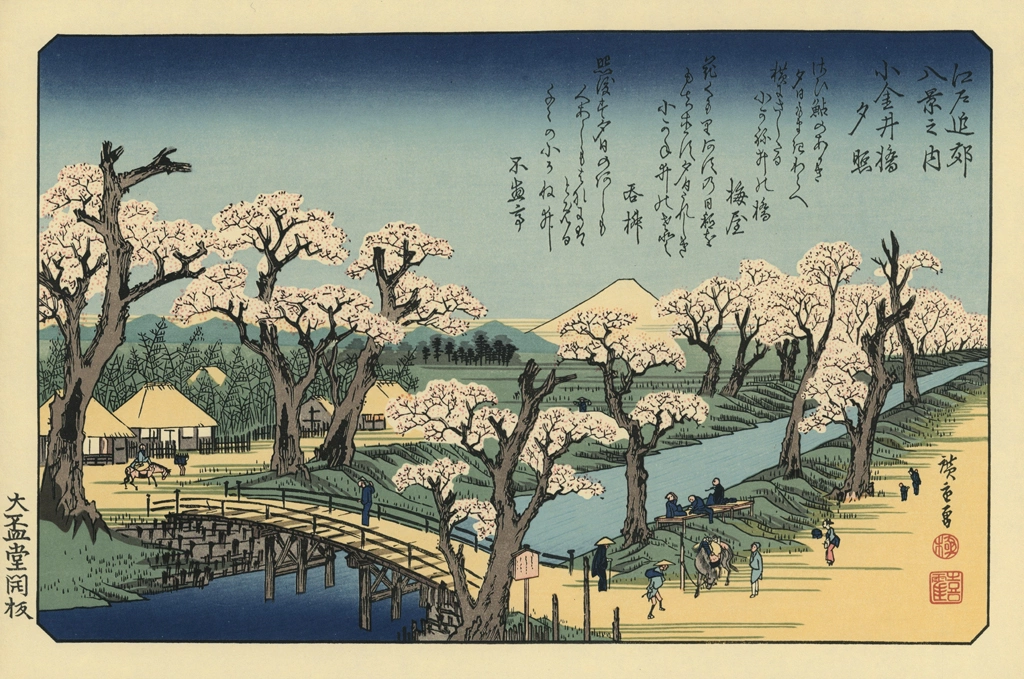
Utagawa Hiroshige (歌川広重, 1797–1858) is often introduced through The Fifty-Three Stations of the Tōkaidō, and for good reason. The series became one of the most celebrated achievements of ukiyo-e landscape printmaking. Yet Hiroshige’s significance extends far beyond a single famous set of images.
What makes Hiroshige distinctive is not simply that he depicted well-known places. It is the way he shaped atmosphere. In his prints, rain, mist, snow, evening light, and shifting seasonal conditions are not background details. They are central compositional forces. Familiar roads, bridges, and riverbanks become emotionally charged environments.
To look at Hiroshige is not only to recognize a place.
It is to enter a mode of seeing.
Landscape as Experience, Not Just Topography
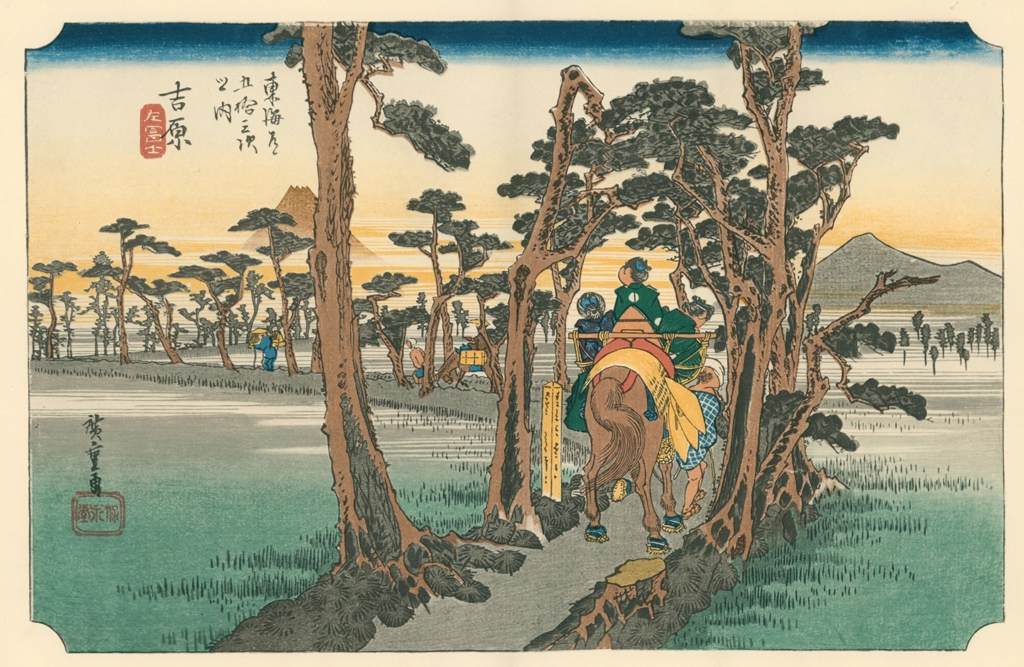
Hiroshige’s prints are often tied to specific locations, stations, routes, and scenic sites. But they rarely function as neutral records. They are carefully structured visual experiences.
Roads curve and recede. Bridges divide and connect space. Travelers gather, pass, and disappear. Weather alters visibility. Distance becomes something felt rather than merely measured. The viewer’s eye is guided through the image with remarkable control, moving between foreground detail and atmospheric depth.
This is one reason Hiroshige’s prints remain compelling even when the physical landscapes themselves have changed. Their power lies not only in what they depict, but in how they organize movement, pause, and attention.
Hiroshige does not simply document place.
He stages the experience of passing through it.
Weather as Structure, Not Decoration
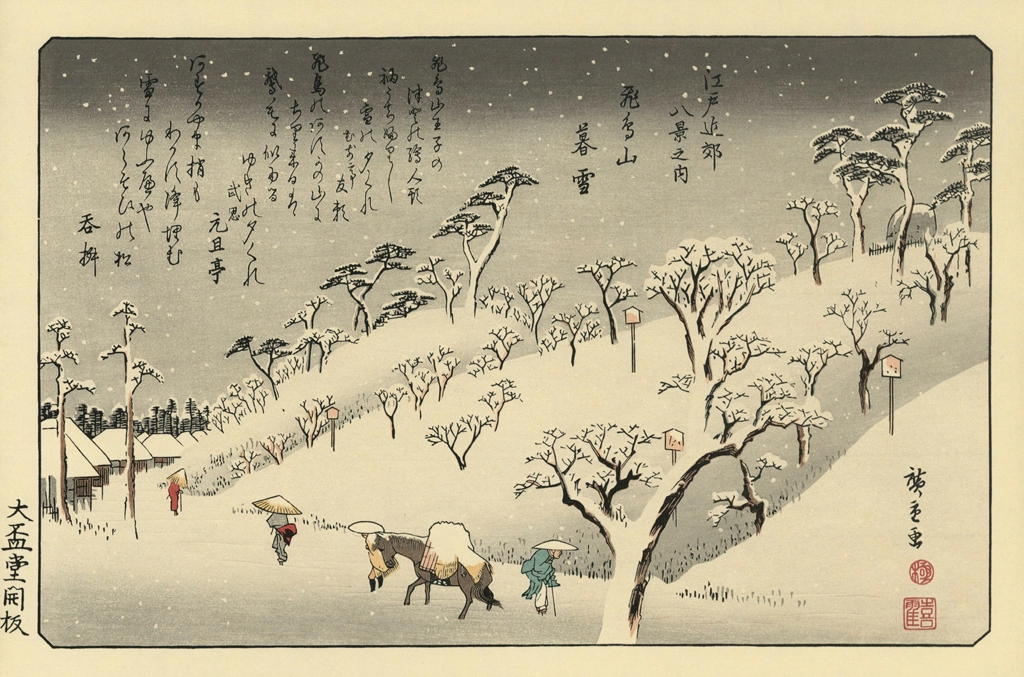
Rain showers, snowfall, haze, wind, twilight, and moonlight are among Hiroshige’s most recognizable motifs. But in his work, weather is not an ornamental effect added to a scene. It is part of the scene’s architecture.
A slant of rain can energize the entire composition. Mist can flatten distance and dissolve boundaries. Snow can quiet a city and make even crowded places feel hushed. Evening light can soften edges and shift the emotional register of an ordinary route.
Through these effects, Hiroshige transforms landscape into a medium of feeling without relying on overt drama. A print does not need a climactic event to hold attention. Weather itself becomes the event.
This quality helps explain why Hiroshige still feels so fresh. His work rewards patient looking. It trains the viewer to notice subtle environmental changes rather than only spectacle.
Travel Culture and the Expanding Imagination of Place
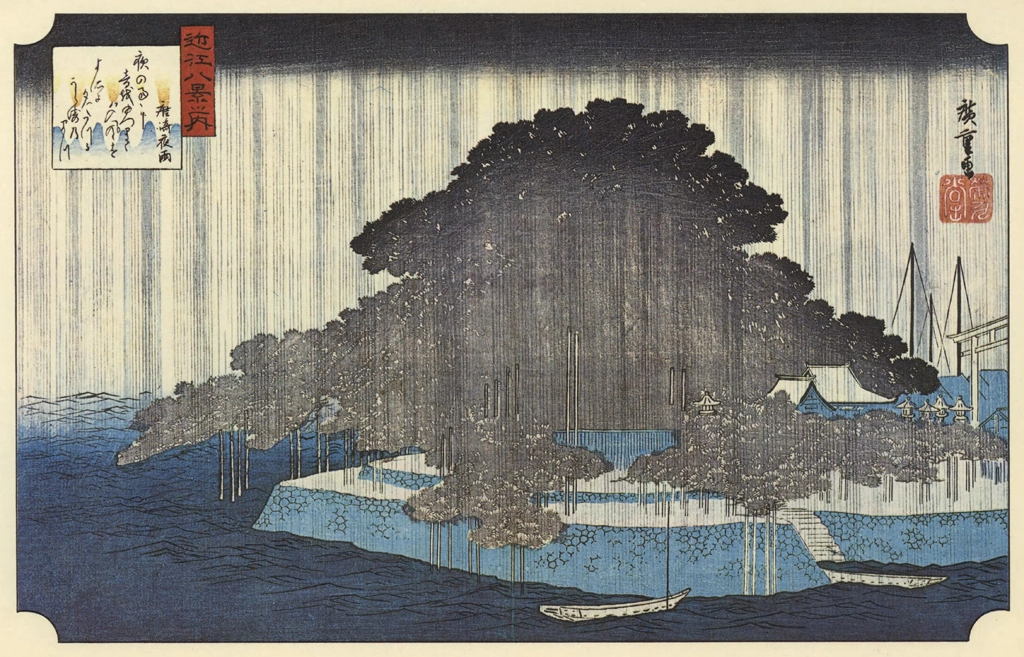
Hiroshige worked during a period when roads, travel culture, guidebooks, and famous-place imagery were increasingly important to popular life. Routes such as the Tōkaidō were not only practical infrastructure. They were also cultural and imaginative pathways.
Prints of stations and scenic points circulated widely. For some viewers, they functioned as souvenirs or visual memories. For others, they offered a form of imagined movement through places they had never visited. A series of prints could create a journey on paper.
Hiroshige participated in this visual circulation, but he also shaped it. His landscapes did not merely reflect an interest in travel. They helped define what travel felt like visually: the rhythm of departure and arrival, the change of weather across distance, the sense of moving through time as well as space.
In that sense, Hiroshige’s work belongs to both geography and media culture.
The Poetics of Everyday Landscape
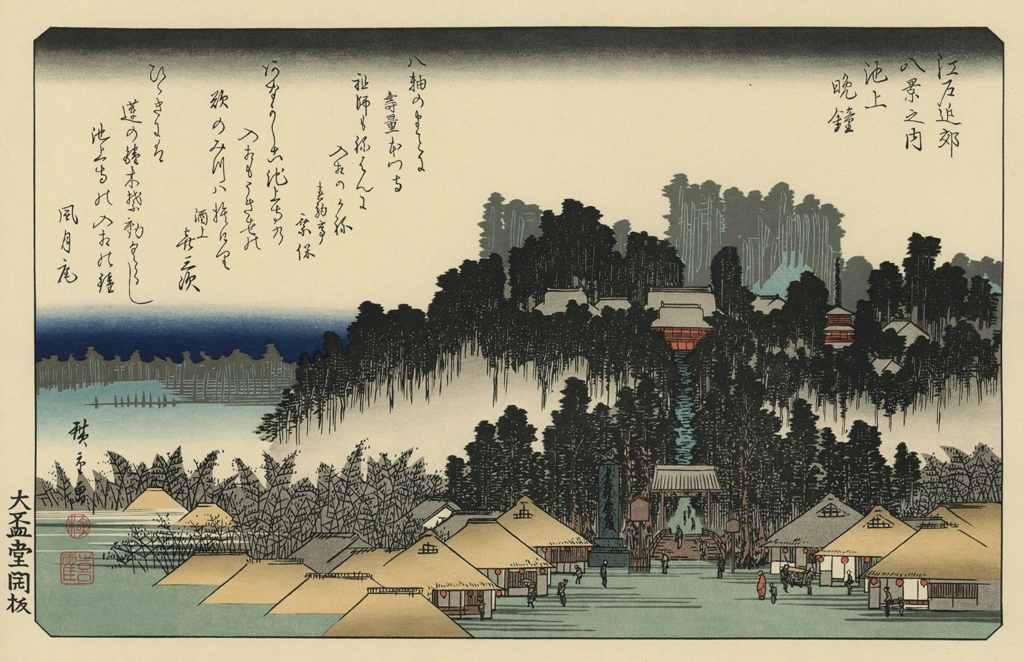
One of Hiroshige’s most remarkable achievements is his ability to make ordinary movement through space feel aesthetically meaningful. Roadsides, riverbanks, ferries, bridges, and town edges become worthy of sustained attention.
This does not mean his landscapes are empty or detached from human life. Human figures are often present, and their small scale is important. They appear as travelers, workers, boatmen, pedestrians, or passing groups. Rather than becoming individualized protagonists, they function as markers of rhythm and relation, helping us sense distance, weather, and terrain.
The result is a kind of pictorial poetry in which place, season, and motion interweave.
Hiroshige’s landscapes are not simply views.
They are temporal scenes, shaped by weather, passage, and the feeling of “in-between.”
Why Hiroshige Still Feels Contemporary
Hiroshige’s landscapes continue to resonate because they do not depend on a single heroic event or dramatic climax. Their strength often lies in transitions: a sudden rain shower, fading light, snow settling on a bridge, travelers crossing a road, the pause between departure and arrival.
In a visual culture saturated with speed and noise, Hiroshige still offers something rare: disciplined attention to atmosphere and a way of seeing place as lived time rather than static scenery.
That is why Hiroshige remains more than a historical master of landscape prints.
He remains an artist of perception.
Leave a Reply