Utagawa Kunisada (歌川国貞, 1786–1865) was one of the most commercially successful and visually influential woodblock print artists of late Edo Japan. Yet in many modern introductions to ukiyo-e, he is often mentioned less frequently than Hokusai or Hiroshige. This can create a misleading impression. Kunisada was not a secondary figure. He was one of the central image-makers of urban Edo.
To understand Kunisada is to understand something essential about the city itself: its theaters, celebrities, fashions, and the visual pleasures of everyday life. His prints did not simply record popular culture. They participated in it, shaped it, and helped define how people saw contemporary style.
If some ukiyo-e artists are remembered for landscape or heroic drama, Kunisada stands out as a master of people, especially people as they appeared in the circulation of fame, performance, and urban taste.
The Artist of the Edo Public
Kunisada worked in a highly competitive print market driven by publishers, audience demand, and fast-moving trends. This was not a slow or isolated art world. It was a bustling visual economy, and Kunisada excelled within it.
His success was not accidental. He had an exceptional ability to produce images that were immediately appealing while remaining formally skilled and compositionally refined. In this sense, Kunisada’s popularity should not be treated as a sign of lesser artistic value. It is better understood as evidence of his precision within mass culture.
He knew how to make an image circulate.
That ability matters. It means that Kunisada’s work gives us direct access not only to artistic technique, but also to how visual desire worked in Edo period society.
Actor Prints and the Performance of Identity
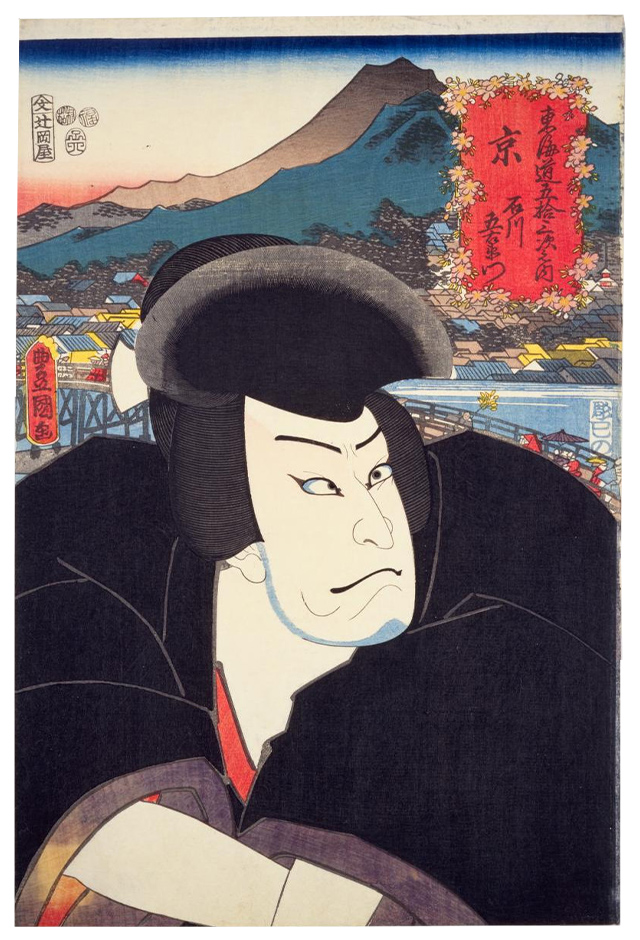
Kunisada is especially celebrated for his yakusha-e (actor prints), and this is one of the best places to see his strengths clearly.
Kabuki actors in Edo were not simply performers on a stage. They were public figures, fashion influences, and objects of fan devotion. Actor prints operated somewhere between portraiture, publicity, and performance memory. Kunisada understood this perfectly.
In his actor prints, costume, pose, facial expression, and gesture carry layered meaning. These are not neutral likenesses. They are images of role-making. An actor is shown not only as an individual person, but as a theatrical presence shaped by character, reputation, and audience expectation.
This gives Kunisada’s actor prints a fascinating double structure:
they capture a person, but they also capture a public persona.
Seen from today, they can feel surprisingly modern. They belong to a media culture in which audiences consumed personality through images, much like celebrity photography, posters, or fan publications in later eras.
Beauties, Fashion, and the Language of the Contemporary
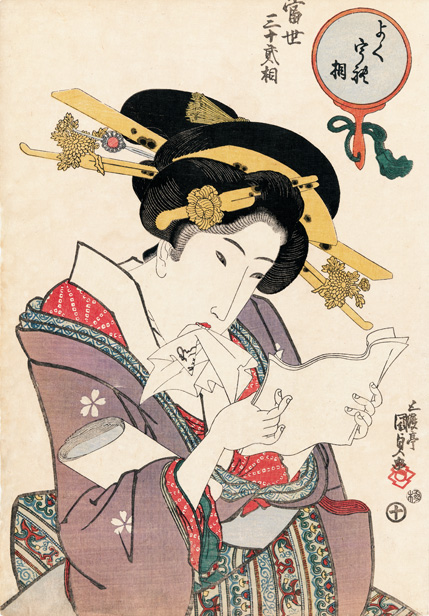
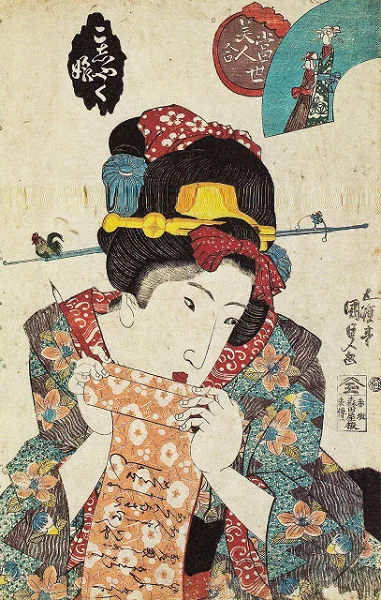
Kunisada’s bijin-ga (pictures of beauties) reveal another major dimension of his work. Here too, he is not simply producing idealized figures. He is constructing images of social type, mood, and contemporary style.
Clothing patterns, hair arrangements, accessories, posture, and facial expression all contribute to meaning. These images often preserve the textures of urban life: what looked stylish, what signaled elegance, what seemed current, what circulated as “taste.”
This is one reason Kunisada remains so valuable for readers of Japanese visual culture. His prints allow us to study not only aesthetics in a narrow sense, but also the coded visual language of everyday modernity within Edo.
Series such as Thirty-Two Physiognomies are especially compelling in this regard. They suggest that expression itself could be categorized, stylized, and enjoyed as a social and visual type. Kunisada’s interest is not only in beauty, but in how feeling, attitude, and personality become legible on the face.
In other words, he is an artist of surfaces, but surfaces here are never shallow. They are where social life becomes visible.
Popularity and Artistic Value
Kunisada’s huge output has sometimes led to uneven evaluation, especially when viewed through modern habits that privilege singular masterpieces over prolific production. But this framework can obscure what made him important in the first place.
Kunisada’s achievement lies partly in his ability to sustain quality and invention within a commercial system. He was working in a field shaped by deadlines, publishers, and changing tastes, and he still produced prints of remarkable elegance, clarity, and cultural specificity.
Rather than asking whether he was “too popular,” a better question may be:
what kinds of visual intelligence are required to become the artist of a city’s taste?
Kunisada offers one answer. He demonstrates that artistic significance can emerge not only through radical rupture, but also through deep fluency in the desires and rhythms of contemporary life.
Why Kunisada Still Matters
Kunisada’s prints remain powerful because they preserve more than images of actors or beautiful women. They preserve ways of looking. They show how a city recognized fame, admired style, and turned everyday appearance into visual culture.
If Hiroshige often gives us weather and distance, and Kuniyoshi gives us pressure and dramatic force, Kunisada gives us something equally essential: the social surface of Edo, where identity, fashion, and performance become visible.
That surface is exactly where much of modern life still happens.
For that reason, Kunisada does not feel distant. He feels legible.
Landscape as Experience, Not Just Description
Hiroshige’s prints are frequently tied to recognizable sites, roads, bridges, stations, and scenic points. But they are rarely just topographical records. They are structured visual experiences.
Roads curve and recede. Bridges divide and connect space. Travelers gather and disperse. Weather changes what can be seen. Distance becomes part of the composition. The eye is guided through movement, pause, interruption, and release.
This is one reason Hiroshige’s work remains compelling even when the actual places have changed dramatically. The enduring power of his prints lies not only in location, but in the emotional logic of how a landscape is inhabited, crossed, or remembered.
He presents place as lived rhythm.
Weather as Structure
Rain showers, snowfall, haze, twilight, moonlight, and shifting skies are among Hiroshige’s most recognizable motifs. But in his work, weather is not decorative atmosphere added after the fact. It is structural.
A diagonal rain pattern can animate an entire image. Mist can flatten depth and soften boundaries. Snow can quiet urban space and transform familiar architecture into a field of stillness. Evening light can slow movement and alter the emotional register of a route.
Through these effects, Hiroshige turns landscape into a medium of feeling without requiring overt narrative drama. The scene does not need a major event. The weather itself becomes the event.
This is one reason his prints continue to feel so contemporary. They train attention toward subtle changes in environment rather than only toward spectacle.
Travel, Media, and the Expanding Imagination of Place
Hiroshige worked in an era when travel routes, guidebooks, and place imagery were becoming increasingly important to popular culture. Roads such as the Tōkaidō were not only physical infrastructure. They were also visual and imaginative systems.
Prints of famous places circulated widely. For some viewers, they functioned as souvenirs or visual memories. For others, they offered a form of imagined travel. Even those who did not journey extensively could move through stations, roads, and scenic points through sequences of prints.
Hiroshige participated in this circulation, but he also shaped it. His prints did not merely reflect an interest in travel. They helped define what travel looked and felt like in visual terms.
In that sense, his art belongs equally to geography and media culture.
The Poetics of the Everyday Landscape
One of Hiroshige’s quiet achievements is his ability to treat ordinary movement through space as aesthetically meaningful. Bridges, riverbanks, roadsides, ferries, and seasonal transitions become worthy of sustained attention.
This does not mean his landscapes are empty or purely contemplative. Human figures are often present, and their scale matters. They are travelers, workers, passersby, and small markers of life moving through weather and terrain. Yet they are rarely turned into individualized protagonists. Instead, they help establish rhythm, measure, and relational scale.
The result is a kind of pictorial poetry in which place, season, and motion interweave.
Hiroshige does not simply show where things are.
He shows how it feels to move through them.
Why Hiroshige Still Feels Contemporary
Hiroshige’s landscapes continue to resonate because they do not depend on a single heroic event or dramatic climax. Their force often lies in transitions: changing weather, passing travelers, fading light, and in-between spaces.
In a visual culture saturated with speed and noise, Hiroshige’s prints still offer something rare: disciplined attention to atmosphere and a way of seeing place as lived time rather than static scenery.
That is why Hiroshige remains more than a historical master of famous views.
He remains an artist of perception.
Leave a Reply